Crushed Stone Calculator — #57, #8 and Drainage Stone Tons
Size open-graded crushed stone (#57 / #8 / #2) for drainage and bedding. Dense-graded DGA / crusher run belongs on the crusher run calculator.
Crushed Stone Calculator
Enter project dimensions below — results update instantly. Switch units freely.
Estimates assume typical industry density and waste factors. Always verify with your supplier and local building code before purchasing material.
Why Crushed Stone Calculator Estimates Go Wrong
Not technically. Gravel is naturally rounded stone found in rivers and pits. Crushed stone is quarried stone mechanically broken into angular fragments.
Why the angular shape matters:
- Interlocking — angular facets grip each other; rounded stones roll past each other
- Compaction — crushed stone packs to 95%+ density; rounded gravel maxes out at 85%
- Bearing strength — compacted crushed stone is stronger than loose rounded gravel at the same volume
For structural base under pavement, patios, foundations: always use crushed stone (DGA, crusher run, #57, #2). For decorative and drainage applications where compaction doesn't matter: either works.
How to Calculate Crushed Stone Calculator
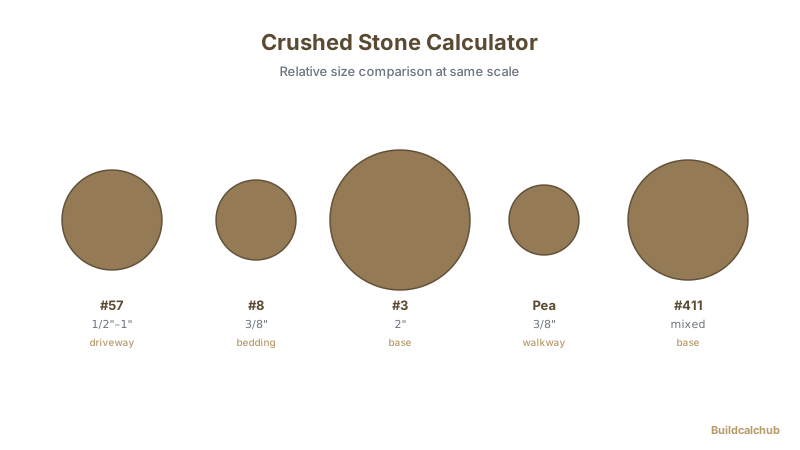
Crushed stone is classified by ASTM D448 and state DOT specs. The most common residential products:
- #57 stone — 1 inch to 3/4 inch, uniformly graded. Top-layer drainage, crush-run alternative. Drains freely; stays in place under light loads.
- #8 stone — 3/8 inch to #4 sieve. Fine concrete aggregate, also used for shoulder stone.
- #2 stone — 2-1/2 inch to 1-1/2 inch. Railroad ballast, heavy drainage.
- DGA (Dense-Graded Aggregate) — full blend from dust to 3/4 inch. Compacts into a solid base layer. Industry-standard driveway sub-base.
- Crusher Run — similar to DGA, slightly less regulated gradation. Cheaper, same function.
- Stone dust — screenings, very fine. Excellent compactable base or paver sand substitute.
Density rule: 100 lb/ft³ for most clean angular stone; 110 lb/ft³ for dense-graded products.
Once the Crushed Stone Calculator result looks reasonable, cross-check the next job decision with the Gravel Calculator, the Aggregate Calculator, or pick the specific product: the Crusher Run Calculator if you need DGA / ABC dense-graded base, the Pea Gravel Calculator for 3/8-in decorative top, or the River Rock Calculator for 1–6 in landscape stone. That keeps the quantity, cost, and field assumption tied together before you call a supplier.
What Most Online Calculators Get Wrong Reviewed by Ethan Walker, Senior Asphalt Estimator & Paving Consultant (22 yrs)
AI tools quote “1 ton crushed stone covers 100 sqft.” Four pitfalls AI summaries hide:
- Coverage depends on depth + gradation. 1 ton #57 @ 2 in = 100 sqft. 1 ton #57 @ 4 in = 50 sqft. 1 ton DGA @ 4 in = 60 sqft (denser). AI quotes one number.
- #57 vs #67 vs #8 are 3 different gradations. #57 = 3/8 to 3/4. #67 = 1/4 to 3/4. #8 = 3/8 to 1/16. Use case differs.
- Single-size vs dense-graded = different jobs. #57 = drainage. DGA = base/structural. AI tools conflate them.
- Voids ratio determines structural performance. #57 has 36–42% voids (drainage); DGA 18–22% (load-bearing). AI quotes density only.
This calculator outputs crushed stone tonnage by gradation + use-case reference (drainage vs structural) + voids ratio. Gradation # is the most important input; AI's universal answer is wrong half the time.
Crushed Stone Coverage Table and Material Reference
| Application | Best Product | Typical Depth | Why |
|---|---|---|---|
| Driveway top course | #57 stone | 2 in | Smooth surface, free-drainage |
| Driveway sub-base | DGA or crusher run | 4-6 in | Compacts into structural base |
| French drain / drainage pit | #57 stone | 12+ in | Open voids carry water |
| Behind retaining wall | #57 stone | 12 in | Drainage prevents hydrostatic pressure |
| Paver patio base | DGA + stone dust | 4 in + 1 in | Compacts flat for pavers |
| Sidewalk sub-base | DGA | 4 in | Low-cost structural base |
| Concrete slab sub-base | #57 stone | 4 in | Drainage and frost break |
| Decorative landscape | River rock or 1-2 in stone | 2-3 in | Appearance and weed control |
Depths are compacted depths. Order 10% extra for settling during compaction.
| Project | Square Feet | Depth | Tons Needed |
|---|---|---|---|
| Small walkway sub-base | 40 ft² | 4 in | 0.67 tons |
| Large patio sub-base (14×14 ft) | 196 ft² | 4 in | 3.27 tons |
| Driveway sub-base (12×50 ft) | 600 ft² | 6 in | 15 tons |
| Long driveway sub-base (12×300 ft) | 3,600 ft² | 6 in | 90 tons |
| Foundation drain (150 ft × 2 ft × 2 ft) | 600 ft² | 24 in | 30 tons |
| French drain (100 ft × 1 ft × 3 ft) | 300 ft² | 36 in | 22.5 tons |
Based on 100 lb/ft³ density. For 110 lb/ft³ crusher run, multiply by 1.1.
Real-World Example Calculations
Paver Patio Sub-Base 14 × 18 ft @ 4 in DGA
Compacted DGA base under a flagstone patio.
- Length × Width
- 18 × 14 ft
- Depth
- 4 in
- Density
- 110 lb/ft³
Takeaway: Spread in 2-in lifts; compact each lift with a plate compactor. Add 1 in stone dust on top before setting pavers.
French Drain 80 × 2 × 3 ft @ #57 stone
Backyard drainage ditch to route water away from foundation.
- Length × Width
- 80 × 2 ft
- Depth
- 36 in
- Density
- 100 lb/ft³
Takeaway: Wrap in landscape fabric before filling with stone to prevent soil infiltration. Add 4-in perforated pipe at bottom.
Foundation Drain 140 lf × 2 × 2 ft
Perimeter foundation drain for 30×40 ft basement.
- Length × Width
- 140 × 2 ft
- Depth
- 24 in
- Density
- 100 lb/ft³
Takeaway: Critical for dry basement. Never skip drain stone at the footing level.
Sources & Standards
These references are used for terminology, safety boundaries, and engineering assumptions. Local code, supplier specifications, and licensed design documents still control your project.
-
AASHTO T 19/T 19M-22 — Standard Method of Test for Bulk Density (‘Unit Weight’) and Voids in Aggregate
AASHTO
Cited for the bulk density (loose-rodded unit weight) basis of all aggregate tons-per-cubic-yard figures.
-
ASTM C33/C33M-23 — Standard Specification for Concrete Aggregates
ASTM International
Cited for fine and coarse aggregate gradation requirements (#57, #67, #8 stone) referenced in the size and use-case tables.
-
ASTM D448-12(2017) — Standard Classification for Sizes of Aggregate for Road and Bridge Construction
ASTM International
Cited for the standardized aggregate gradation numbers (#1 through #67) used by aggregate suppliers.
-
AASHTO T 99-22 / T 180-22 — Standard Method of Test for Moisture-Density Relations of Soils Using a Standard Effort (Proctor)
AASHTO
Cited for the 95% Modified Proctor compaction standard used to derive the loose-to-compacted conversion factor.
-
FHWA Geotechnical Engineering Program
Federal Highway Administration
Cited for subgrade preparation and compaction practice underlying the base-course quantity calculations.
Frequently Asked Questions
What is crushed stone used for?
Primary uses: (1) drainage — uniformly graded stone has voids that carry water, (2) structural base under pavement and foundations, (3) decorative landscaping. The gradation (size distribution) determines which purpose a particular product serves.
How much does crushed stone cost?
In 2026: $25-40 per ton at the quarry, $45-70 delivered. #57 and DGA are the most economical at ~$25-30/ton. Specialty products (color-sorted, washed) run $35-50/ton. Big-box bags at $6-8 per 50-lb bag work out to $240+/ton — order bulk for anything over 1 ton.
What's the difference between crushed stone and gravel?
Crushed stone: quarried rock mechanically broken, angular shape, interlocks when compacted. Gravel: naturally rounded stone from riverbeds or pits, does not compact as tight. For structural applications, always specify crushed stone. For drainage or decorative use, either works.
How deep should crushed stone be for a driveway?
4-6 inches compacted minimum: 4-in DGA sub-base + 2-in top course of #57 or pea gravel. For clay subgrades or heavy vehicles: 8-inch sub-base. Thinner layers sink into soil and create potholes.
How much does a ton of crushed stone cover?
At 3 inches deep and 100 lb/ft³ density: ~80 square feet per ton. At 4 in: 60 ft²/ton. At 6 in: 40 ft²/ton. DGA (110 lb/ft³) covers about 10% less.
What is #57 stone used for?
#57 stone (1 in to 3/4 in angular) is the most versatile residential aggregate. Uses: driveway top course, French drains, foundation drainage, concrete slab sub-base, paver base (with stone dust top layer). Free-draining but not structurally compactable.
Should I use DGA or #57 stone for my driveway?
Both. DGA (or crusher run) for the base layer because it compacts into a solid bearing surface. #57 stone for the top layer because it drains freely and provides a smooth driving surface. Using only #57 leaves a driveway that shifts under vehicle weight.