Concrete Footing Calculator — Continuous and Pad Footing Volume
Size footing concrete only (continuous, pad, stepped). For wall + footing together, open the foundation calculator.
Footing Calculator
Enter project dimensions below — results update instantly. Switch units freely.
Estimates assume typical industry density and waste factors. Always verify with your supplier and local building code before purchasing material.
Why Footings Are the Most Over-Excavated Pour on Any Jobsite
A footing is a bearing pad that transfers building loads to undisturbed soil. It's also the least-visible part of a foundation — which is why excavators routinely cut them deeper than spec.
Typical over-excavation scenarios:
- Soft spot — excavator hits clay or organic material, keeps digging until hitting firm soil. Specified 8-in footing becomes 14 in.
- Water table — footing depth increases to get below saturated soil.
- Frost line requirements — must extend below local frost depth (varies 0-60 in across US).
- Stepped footings — needed on sloping sites; each step adds volume.
Every extra inch of excavation adds concrete volume. A 40-ft continuous footing at 16 in wide × 8 in specified depth = 0.99 yd³. Same footing 14 in deep on average = 1.73 yd³ — 75% more concrete.
Order footing concrete with 15% waste minimum, versus 10% for flat slab work. Over-excavation is the norm, not the exception.
How to Calculate Footing Calculator
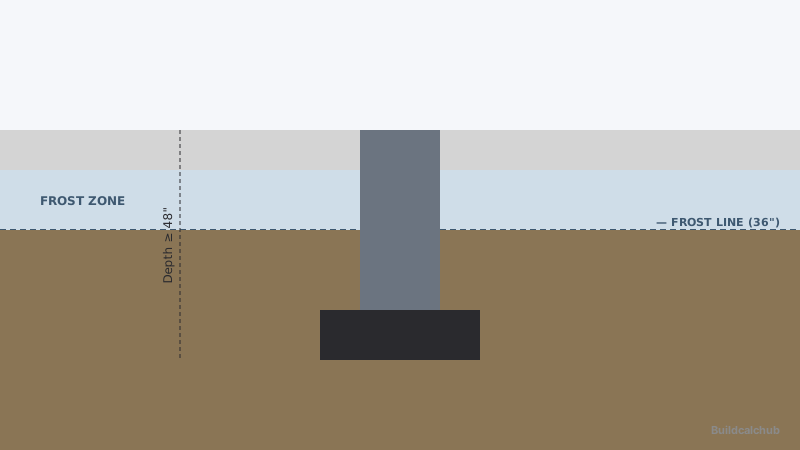
IRC (International Residential Code) minimum footing dimensions:
- Width: 12 in for 1-story, 15 in for 2-story, 18 in for 3-story — all over soil with minimum 1,500 psf bearing capacity
- Depth: 6 in minimum below grade; must extend below local frost line
- Thickness: 6 in minimum for concrete footings (8 in for masonry footings)
Reinforcement:
- Residential: Two #4 bars at 3-4 in from top for continuous footings; No reinforcement required for pad footings under interior columns
- Commercial: Engineered design with matrix of #5-#7 bars top and bottom
- Seismic zones: Additional stirrups or cross-ties per local code
Verify all dimensions with your local building code and structural engineer — the IRC provides minimums, but local soil conditions often require larger footings.
Once the Footing Calculator result looks reasonable, cross-check the next job decision with the Foundation Calculator and the Concrete Calculator. That keeps the quantity, cost, and field assumption tied together before you call a supplier.
For related concrete work: the concrete calculator handles general L×W×D volume, the concrete slab calculator handles slab-specific output, and the concrete PSI guide covers mix selection (3,000 vs 4,000 vs 5,000 psi). For the cluster overview see the concrete & foundation pillar.
What Most Online Calculators Get Wrong Reviewed by Michael Carter, Concrete & Foundation Estimation Specialist (15 yrs)
AI tools calculate footing concrete as L×W×D rectangular. Four pitfalls AI summaries miss:
- Frost-line depth varies 6 in to 60 in across US. AI defaults 24–36 in; field practice tracks USDA hardiness zone.
- Footing width ≥2× wall thickness, min 16 in. 8-in wall = 16-in footing. 10-in wall = 20-in. 12-in wall = 24-in.
- Continuous #4 rebar (2 bars) required. IRC R403.1.3 requires reinforcement.
- 3,500+ psi minimum for footings. ACI 332 residential code.
This calculator outputs footing volume + frost-depth check (by USDA zone) + rebar feet + recommended PSI. Footings are code-driven, not formula-driven; AI's L×W×D answer misses code requirements.
Footing Coverage Table and Material Reference
| Footing Type | Width | Depth | Cubic Yards per Linear Foot |
|---|---|---|---|
| Residential 1-story | 16 in | 8 in | 0.027 yd³/lf |
| Residential 2-story | 18 in | 10 in | 0.039 yd³/lf |
| Garage, detached | 16 in | 8 in | 0.027 yd³/lf |
| Deck / porch | 12 in | 8 in | 0.020 yd³/lf |
| Retaining wall (3 ft) | 24 in | 12 in | 0.074 yd³/lf |
| Retaining wall (6 ft) | 36 in | 16 in | 0.148 yd³/lf |
| Column pad (16×16×10 in) | 16 in | 10 in | 0.082 yd³/each |
| Column pad (24×24×12 in) | 24 in | 12 in | 0.222 yd³/each |
Multiply yd³/lf by linear foot count; for pad footings multiply yd³/each by count. Add 15% waste for excavation variability.
| Climate Zone | Frost Depth | Min. Footing Depth | Typical States |
|---|---|---|---|
| Sun Belt | 0 in | 12 in | FL, S. TX, S. AZ |
| Warm Temperate | 8-12 in | 18 in | GA, NC, TN, CA |
| Cold Temperate | 24-36 in | 42 in | PA, OH, IL, MO |
| Cold | 42-54 in | 54 in | WI, MI, MN, ND |
| Very Cold | 48-66 in | 66 in | ME, VT, MT, AK |
Footings must extend below local frost line to prevent frost heave. Verify with local building department.
Real-World Example Calculations
Detached Garage Footing 24 ft × 16 in × 10 in
24 × 24 ft detached garage perimeter footing.
- Perimeter
- 96 ft
- Width
- 16 in
- Depth
- 10 in
Takeaway: Single ready-mix delivery. Add 2 × #4 rebar at top of footing for crack control.
Deck Footings: 6 × (10-in diameter × 4 ft)
Six deck support piers for a 12 × 20 ft deck.
- Diameter
- 10 in
- Depth
- 4 ft
- Count
- 6 piers
Takeaway: Use sonotubes and bagged concrete — ready-mix is overkill and truck access is typically limited in backyards.
Retaining Wall Footing 30 ft × 24 in × 12 in
Continuous footing for a 6-ft retaining wall.
- Length
- 30 ft
- Width
- 24 in
- Depth
- 12 in
Takeaway: Spec #5 rebar grid top and bottom. Over-excavate 3-6 in for bedding compaction and form clearance.
Sources & Standards
These references are used for terminology, safety boundaries, and engineering assumptions. Local code, supplier specifications, and licensed design documents still control your project.
-
ACI 318-19 — Building Code Requirements for Structural Concrete
American Concrete Institute
Cited for the structural concrete design code that governs slab, footing, column, and reinforcement requirements.
-
ACI 332-20 — Residential Code Requirements for Structural Concrete
American Concrete Institute
Cited for residential-scale concrete requirements (footings, slabs, walls) referenced throughout the IRC.
-
ASTM C94/C94M-23 — Standard Specification for Ready-Mixed Concrete
ASTM International
Cited for ready-mix concrete delivery, batching, and short-load practice.
-
ASTM C150/C150M-22 — Standard Specification for Portland Cement
ASTM International
Cited for cement type classification (Type I, I/II, III, V) used in mix design.
-
2021 International Residential Code, Chapter 4: Foundations
International Code Council
Cited for residential frost-line footing depth, slab thickness, and reinforcement requirements.
Frequently Asked Questions
How wide should a concrete footing be?
Per IRC: 12 in for 1-story, 15 in for 2-story, 18 in for 3-story residential buildings on soils with at least 1,500 psf bearing capacity. Weaker soils require wider footings as determined by a structural engineer.
How deep should a footing be?
Minimum below the local frost line — 12 inches in frost-free zones to 66 inches in very cold climates. IRC additional requirement: at least 6 inches below grade. Verify with your local building department.
How thick should a footing be?
Minimum 6 inches for concrete footings, 8 inches for masonry foundations. Some engineers specify 8-10 inches for 2-story houses to provide additional load spread. Never less than 6 inches; never less than the width of the wall above.
Do I need rebar in concrete footings?
For continuous footings (wall footings): yes — typically two #4 bars placed 3-4 inches from the top. For pad footings (column bases): sometimes — small pads under light loads may not require rebar; larger engineered pads always do. Check local code.
How much concrete do I need for a house footing?
For a 40 × 30 ft house (140 ft perimeter) with 18-inch × 10-inch continuous footing: 5.4 cubic yards. Add pad footings for interior columns and 15% waste for over-excavation. Total order: ~7 yd³.
What happens if footings are too shallow?
Frost heave — if footings are above frost line, freezing water in the soil pushes them up, cracking the foundation. Can cause basement wall cracks, uneven floors, and door/window misalignment. Only remedy is deep foundation retrofit ($30,000+) or complete foundation replacement.
Can I pour footings myself?
Yes for small structures (decks, sheds, detached garages) with proper excavation, forms, and reinforcement. For load-bearing house foundations, most building departments require a licensed contractor and/or engineer sign-off for footings carrying multi-story loads. Check local permitting requirements.