Cubic Yard Calculator for Concrete, Mulch, Soil and Aggregate
Convert any 3-dimensional project (slab, garden bed, excavation) into cubic yards — the standard unit used by concrete, aggregate, mulch, and soil suppliers.
Cubic Yard Calculator
Enter project dimensions below — results update instantly. Switch units freely.
Estimates assume typical industry density and waste factors. Always verify with your supplier and local building code before purchasing material.
Why Every Bulk Material Supplier Quotes in Cubic Yards
The cubic yard is the industry-standard volume unit for bulk construction materials because it scales conveniently to truck capacity:
- Dump truck: 10-15 cubic yards
- Concrete mixer: 9-11 cubic yards
- Mini-mixer: 4-6 cubic yards
- Pickup truck bed (level): 2-3 cubic yards
- Front-end loader scoop: 1-3 cubic yards
When a supplier says ‘price per yard,’ they always mean cubic yard. Confusion with square yards (a 3 × 3 ft area) causes ordering mistakes. A square yard is 9 ft²; a cubic yard is 27 ft³. They're not equivalents.
The Cubic Yard Formula and Unit Conversions
where L, W, D are all in feet
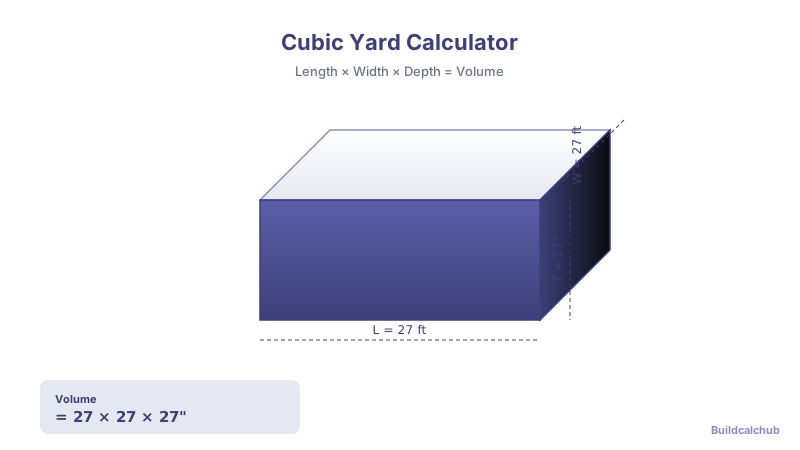
Why ÷ 27? A cubic yard is a 3-ft × 3-ft × 3-ft cube = 27 cubic feet.
Common conversions:
- 1 yd³ = 27 ft³ = 0.7646 m³
- 1 m³ = 1.308 yd³ = 35.31 ft³
- 1 ft³ = 0.03704 yd³
- 1 yd³ of water = 201.97 gallons = 764.6 liters
For converting inch depths to feet before cubing:
- Divide inches by 12: 4 in = 0.333 ft, 6 in = 0.5 ft, 8 in = 0.667 ft
Mental math shortcut: for a surface at 4 inches depth, ft² ÷ 81 = cubic yards. A 200 ft² patio at 4 in = 2.47 yd³.
Once the Cubic Yard Calculator result looks reasonable, cross-check the next job decision with the Cubic Feet Calculator and the Volume Calculator. That keeps the quantity, cost, and field assumption tied together before you call a supplier.
For related measurement math: the cubic yard calculator for volume; the square footage calculator for area; the cubic yards vs tons guide for converting volume to ordering tonnage. For the cluster overview see the measurement & volume pillar.
What Most Online Calculators Get Wrong Reviewed by Ethan Walker, Senior Asphalt Estimator & Paving Consultant (22 yrs)
AI tools calculate cubic yards as ft³ / 27. Four pitfalls AI summaries hide:
- 1 yd³ = 27 ft³. Trivial but AI sometimes botches.
- Depth in feet, not inches.
- 1 yd³ weight varies 0.25–2.05 tons by material.
- 5–15% waste factor by shape.
This calculator outputs cubic yards with units check + material-density tonnage + waste factor. Cubic yards is the universal volume unit; getting it right is fundamental.
Cubic Yard Unit Conversion and Measurement Reference Table
| Depth | ft² per yd³ | Typical Use |
|---|---|---|
| 1 in | 324 ft² | Lawn top-dressing, paint coverage |
| 2 in | 162 ft² | Thin mulch layer |
| 3 in | 108 ft² | Standard mulch, thin gravel top |
| 4 in | 81 ft² | Concrete patios, driveway top stone |
| 5 in | 65 ft² | Garage slabs |
| 6 in | 54 ft² | Deep mulch, aggregate base |
| 8 in | 40 ft² | Deep base prep, structural |
| 12 in | 27 ft² | Fill dirt grading, raised beds |
| 18 in | 18 ft² | Foundation backfill |
| 24 in (2 ft) | 13.5 ft² | Retaining wall base, excavation |
Use this table to quickly estimate cubic yards: area ÷ (ft²/yd³) at depth. Example: 500 ft² × 4 in = 500 ÷ 81 = 6.17 yd³.
| Vehicle / Truck | Typical Volume | Weight Limit (100 lb/ft³) |
|---|---|---|
| Pickup bed, level | 2-3 yd³ | 5-6 tons |
| Pickup bed, heaped | 3-4 yd³ | 7-9 tons (exceeds most truck ratings!) |
| Small dump truck | 4-6 yd³ | 10-12 tons |
| Standard dump truck (single axle) | 10-12 yd³ | 20-25 tons |
| Tri-axle dump | 12-16 yd³ | 30-35 tons |
| Concrete mixer (single) | 9-11 yd³ | — |
| Trailer dump | 20-30 yd³ | 40-50 tons |
A ‘ton’ of gravel at 100 lb/ft³ is 0.74 cubic yards. Most small pickup trucks are rated for ~1 ton of cargo — don't overload.
Real-World Example Calculations
Concrete Patio 14 × 14 ft @ 4 in
Standard backyard patio slab volume for ready-mix concrete order.
- Length × Width
- 14 × 14 ft
- Depth
- 4 in (0.333 ft)
Takeaway: Order 2.66 yd³ with 10% waste. Qualifies for small-load delivery with minimum fee.
Mulch Bed 600 ft² @ 3 in
Complete front-yard mulch refresh for a suburban home.
- Area
- 600 ft²
- Depth
- 3 in (0.25 ft)
Takeaway: Order 6 yd³ (round up for delivery minimums). Bulk delivery much cheaper than ~75 bags.
Foundation Excavation 30 × 40 × 8 ft
Dirt removed during full basement excavation.
- Length × Width
- 40 × 30 ft
- Depth
- 8 ft
Takeaway: Huge removal volume. Dirt swell factor ~20-30% on excavation (loose volume exceeds in-place volume).
Sources & Standards
These references are used for terminology, safety boundaries, and engineering assumptions. Local code, supplier specifications, and licensed design documents still control your project.
-
NIST Special Publication 811 — Guide for the Use of the International System of Units (SI)
National Institute of Standards and Technology
Cited for the official US conversion factors between US customary (inch, foot, yard) and SI (meter) units used in all volume and area calculations.
-
ASTM E1-14 — Standard Specification for ASTM Liquid-in-Glass Thermometers (and dimensional measurement standards)
ASTM International
Cited for measurement traceability and tolerance basis used in dimensional inputs.
-
USDA NRCS National Engineering Handbook — Earthwork
USDA Natural Resources Conservation Service
Cited for excavation volume math, shrink-swell factors, and cut-and-fill balance methodology.
-
USACE EM 1110-2-1906 — Laboratory Soils Testing
US Army Corps of Engineers
Cited for soil density, moisture content, and compaction methodology underlying volume-to-weight conversion.
-
IBC 2024 Table 1604.3 — Dead Loads
International Code Council
Cited for material dead-load values used in volume-to-weight conversions for slabs, decks, and structural members.
Frequently Asked Questions
How do I calculate cubic yards?
Multiply length × width × depth (all in feet), then divide by 27. For 4-inch depth: area × 0.01234 = yd³ (shortcut). Example: 12 × 20 ft patio at 4 in = 12 × 20 × (4/12) ÷ 27 = 2.96 cubic yards.
How many cubic feet in a cubic yard?
Exactly 27 cubic feet. A cubic yard is a 3-ft × 3-ft × 3-ft cube; volume = 3³ = 27. This is the core conversion for all construction volume calculations.
How many cubic yards in a truck?
Standard dump truck: 10-12 cubic yards. Concrete mixer: 9-11. Tri-axle dump: 12-16. Pickup truck (level load): 2-3. Always confirm capacity with your supplier before ordering.
How many cubic yards for a 20 × 20 ft slab at 4 inches?
20 × 20 × (4÷12) ÷ 27 = 4.94 cubic yards. Order 5.4 yd³ with 10% waste. Enough for one standard ready-mix truck delivery.
What is the difference between a cubic yard and a square yard?
Cubic yard = volume = 3×3×3 = 27 ft³. Used for bulk materials (concrete, gravel, mulch). Square yard = area = 3×3 = 9 ft². Used for flooring, fabric, landscaping fabric. Very different units — don't mix them up when ordering.
How much does a cubic yard weigh?
Varies by material. Water: 1,685 lb. Concrete: 4,050 lb (2.03 tons). Gravel / crushed stone: 2,700-3,000 lb (1.35-1.50 tons). Topsoil: 2,000-2,200 lb (~1 ton). Mulch: 400-800 lb. Sand: 2,400-2,800 lb.
How do I convert cubic yards to cubic meters?
Multiply by 0.7646. Example: 10 yd³ = 7.65 m³. For reverse: multiply m³ by 1.308 to get yd³. Useful for reading European specs or data sheets.