Asphalt Thickness Calculator — AASHTO Structural Number Sections
Spec a full pavement section—surface, binder and base—using AASHTO-style structural number thinking for driveway, parking and road traffic classes.
Asphalt Thickness Calculator
Enter project dimensions below — results update instantly. Switch units freely.
Estimates assume typical industry density and waste factors. Always verify with your supplier and local building code before purchasing material.
Why Asphalt Thickness Calculator Estimates Go Wrong
Engineers don't talk about ‘asphalt depth.’ They specify a pavement section — a layered structure where each course performs a different mechanical role.
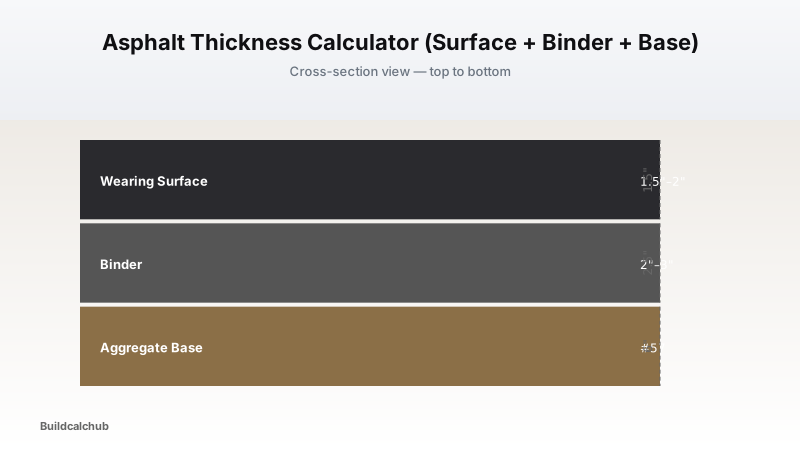
- Surface course (wearing course) — resists tire abrasion, weather, and chemical attack. Fine aggregate, polymer-modified binder for high-traffic.
- Binder course (intermediate) — spreads vertical load before it reaches the base. Larger aggregate, stiffer binder.
- Base course — primary structural layer. Coarse aggregate, lower binder content. Often a stabilised aggregate rather than asphalt for cost-effective designs.
This calculator handles the asphalt portions only — the aggregate sub-base is a separate calculation. Use AASHTO Pavement Design Guide method for full design including subgrade resilient modulus.
Traffic Class Decision Wizard: Set the 3-Layer Section Before You Run the Calculator
The calculator above takes Surface, Binder, Base as three independent inputs. To use them correctly, pick a traffic class first — the AASHTO 1993 method links traffic ESALs to a target structural number (SN), which in turn fixes the 3-layer thickness combination. Use the table below to set each input before pressing Calculate, then use the calculator to size the volume / tonnage for ordering.
| Use case | Design ESALs (20 yr) | Surface (in) | Binder (in) | Aggregate Base (in) | Required SN |
|---|---|---|---|---|---|
| Residential drive (car only) | < 5,000 | 2 in | 0 (omit) | 4 in crusher run | SN ≈ 1.3 |
| Residential drive (pickup / SUV) | 5,000–25,000 | 2.5–3 in | 0 (omit) | 4–6 in crusher run | SN ≈ 1.7 |
| Small commercial / 5-stall lot | 50,000–200,000 | 3 in | 2 in | 6 in DGA / 21A | SN ≈ 2.4 |
| Strip-center lot, 50–100 stalls | 200,000–1,000,000 | 2 in | 3 in | 8 in DGA | SN ≈ 3.2 |
| Local road (collector) | 1,000,000–3,000,000 | 2 in | 4 in | 10 in DGA | SN ≈ 3.9 |
| Arterial highway | 3,000,000–10,000,000 | 2 in SMA | 5 in | 12 in DGA + 6 in subbase | SN ≈ 4.6 |
| Interstate highway | > 10,000,000 | 2–3 in SMA | 6 in | 14 in DGA + 8 in subbase | SN ≈ 5.4 |
| Heavy-truck logistics yard | 5,000,000–20,000,000 + 18-wheeler axle loads | 3–4 in | 5 in | 16 in DGA | SN ≈ 5.0+ |
Use SN = a₁D₁ + a₂D₂m₂ + a₃D₃m₃ where a₁ = 0.42 (surface), a₂ = 0.36 (binder), a₃ = 0.12 (aggregate base), m = 1.0 (good drainage). For poor drainage, m = 0.80 — you’ll need 25% more base thickness for the same SN.
Subgrade Strength Adjustment: CBR Class × Climate Zone
The base table assumes CBR-5 subgrade in temperate climate. Adjust the aggregate base layer:
| Subgrade CBR | Temperate (Mid-Atl) | Cold (Northeast / Upper Midwest) | Hot (Southwest / FL) | Wet / poor drainage |
|---|---|---|---|---|
| CBR < 3 (very soft clay) | 1.5× base + geotextile | 1.8× base + drainage | 1.4× base | 2.0× base + chemical stab |
| CBR 3–5 (typical residential) | 1.0× (baseline) | 1.25× base (frost heave) | 0.9× base | 1.3× base |
| CBR 5–10 (sandy loam) | 0.85× base | 1.10× base | 0.80× base | 1.10× base |
| CBR > 10 (gravel, rock) | 0.70× base (minimum 4 in) | 0.85× base | 0.65× base (min 4 in) | 0.95× base |
Get subgrade CBR from a soils report or visual classification (USCS): GW/GP gravels = CBR 10+; SW/SP sands = CBR 8–15; ML/CL silts & lean clays = CBR 3–7; CH fat clays = CBR < 3. For freeze zones the frost-depth (NOAA atlas) sets the minimum total section regardless of SN.
How to Calculate Asphalt Thickness Calculator
Each layer has a structural number (SN) contribution. The required total SN comes from traffic ESALs (equivalent single-axle loads) over the design life:
where: a = layer coefficient, D = thickness, m = drainage factor
Typical layer coefficients:
- HMA surface (a₁): 0.40-0.44
- HMA binder (a₂): 0.34-0.40
- Bituminous base (a₃): 0.30-0.34
- Aggregate base: 0.10-0.14
- Subbase: 0.06-0.10
For a typical highway with 2 million ESALs over 20 years on a CBR-5 subgrade:
- Required SN ≈ 4.0
- Section: 2 in surface (SN 0.84) + 3 in binder (SN 1.05) + 8 in aggregate base (SN 1.0) + 12 in subbase (SN 1.2) = SN 4.09 ✓
Local DOTs publish their own thickness charts derived from AASHTO — consult these before final design.
After the section is set, convert surface + binder tons with the asphalt calculator, and check loose-order tons in the compaction calculator.
Residential single-layer depth presets live on the asphalt depth calculator. After the section is locked, convert asphalt tons with the asphalt calculator and read layer intent in the asphalt thickness guide.
What Most Online Calculators Get Wrong Reviewed by Ethan Walker, Senior Asphalt Estimator & Paving Consultant (22 yrs)
The AASHTO 1993 thickness model is 30+ years old and most online thickness calculators copy the surface layer math without checking what compounds against it. The four errors that destroy a thickness spec:
- Base compaction sanity check is missing. The thickness calculator outputs a binder + base section assuming the base is compacted to 95% AASHTO T 180. In residential builds the actual base is typically 88–92% (homeowner-grade equipment can’t reach 95%). At 90% compaction, the base structural number (a₃ layer coefficient) drops from 0.12 to ~0.09 — 25% loss of structural capacity. Apply CBR/climate multiplier from the table above; verify nuclear-gauge density on first lift.
- Climate isn’t in most online tools. AASHTO 1993 m-factor (drainage coefficient) ranges from 0.80 (poor drainage, freeze) to 1.40 (excellent drainage). Calculators that ignore m-factor over-promise thickness performance by 15–40% in poor-drainage zones. Mid-Atlantic / Northeast in winter is at best m = 1.0; with poor sub-drainage drop to 0.80.
- Subgrade resilient modulus assumption. The default 7,500 psi (CBR ≈ 5) is for “typical residential.” Soft clays (CBR < 3) require 1.5–2.0× the aggregate base for the same SN. Calculators that hardcode CBR-5 over-design hard rock subgrades and dangerously under-design clay subgrades. Get a soils report before any commercial thickness spec.
- (KOL counter-view) Total structural number isn’t enough — perpetual pavement concept dominates 2026 design. The Asphalt Pavement Alliance and FHWA Long-Life Pavement Initiative now recommend “perpetual pavement” design for any project with > 30 yr design life: bottom-up fatigue layer of rich-binder asphalt (PG XX-22 + 6.5% binder) below the structural binder course. The bottom layer never cracks; only the surface needs periodic mill-and-overlay. AASHTO 1993 SN method doesn’t capture this — you have to spec the rich-bottom layer explicitly. The marginal cost (~$3–5/sqft) earns back in 1 avoided rebuild cycle.
Asphalt Thickness Depth and Thickness Reference Table
| Traffic Class (ESAL) | Surface | Binder | Aggregate Base | Total HMA |
|---|---|---|---|---|
| Local roads (<100K) | 2 in | 0 | 6 in | 2 in |
| Collector (100K-500K) | 2 in | 2 in | 8 in | 4 in |
| Minor arterial (500K-2M) | 2 in | 3 in | 10 in | 5 in |
| Major arterial (2M-10M) | 2 in | 4 in | 10 in | 6 in |
| Interstate (>10M) | 2 in | 5 in | 12 in | 7 in |
| Industrial yard (HS-25) | 3 in | 4 in | 12 in | 7 in |
ESAL = equivalent 18-kip single axle loads over design life. Verify with state DOT spec book.
| Climate Zone | Freeze-Thaw Cycles | Thickness Multiplier | Frost Depth |
|---|---|---|---|
| Sun Belt (FL, AZ, S. CA) | <5 | 0.90 | 0 in |
| Temperate (NC, TN) | 20-40 | 1.00 | 12-18 in |
| Cold (PA, OH) | 60-90 | 1.10 | 30-36 in |
| Severe (MN, ND, ME) | 100+ | 1.20 | 48-60 in |
Multiply baseline AASHTO thickness by climate factor. Frost depth dictates aggregate sub-base depth.
Real-World Example Calculations
Local Subdivision Street 1,000 ft × 26 ft
ESAL 80,000 over 20 years; CBR-7 subgrade in central Pennsylvania.
- Surface course
- 2 in
- Binder course
- 0 in
- Base course
- 2 in
- Length × Width
- 1000 × 26 ft
Takeaway: Add 8 in compacted #57 stone base underneath. Use polymer-modified surface mix for crack resistance.
Major Arterial 0.5 mi × 48 ft
ESAL 5M over 20 years; suburban arterial road.
- Surface course
- 2 in
- Binder course
- 4 in
- Base course
- 0 in
- Length × Width
- 2640 × 48 ft
Takeaway: Use Superpave mix design with PG 70-22 binder. Tack coat between every lift — non-negotiable.
Industrial Loading Pad 200 × 100 ft
HS-25 truck loading; daily 80,000 lb axle traffic.
- Surface course
- 3 in
- Binder course
- 4 in
- Base course
- 0 in
- Length × Width
- 200 × 100 ft
Takeaway: Spec 12 in compacted DGA. Consider rigid concrete pavement for heaviest loading zones.
Sources & Standards
These references are used for terminology, safety boundaries, and engineering assumptions. Local code, supplier specifications, and licensed design documents still control your project.
-
AASHTO Guide for Design of Pavement Structures (1993)
AASHTO
Referenced for the structural number (SN) method, layer coefficients (a₁–a₃) and drainage factor (m) used in this calculator.
-
FHWA Superpave Pavement Design
Federal Highway Administration
Referenced for Superpave mix-design selection by climate (PG binder grade) and traffic level.
-
NAPA QIP-128 / Asphalt Pavement Magazine technical notes
National Asphalt Pavement Association
Referenced for compacted HMA density (145 lb/ft³) and surface/binder lift-thickness conventions.
-
Asphalt Institute MS-22: Construction of Hot Mix Asphalt Pavements
Asphalt Institute
Referenced for lay-down temperature, lift thickness limits and tack-coat practice between courses.
-
FHWA Long-Term Pavement Performance (LTPP) Program
Federal Highway Administration
Referenced for climate-zone freeze-thaw multipliers and frost-depth design guidance.
Frequently Asked Questions
What is the difference between asphalt depth and asphalt thickness?
Depth (this site): compacted inches of a single HMA surface for DIY use-case presets—see the asphalt depth calculator. Thickness here: the full pavement section (surface + binder + base) sized with AASHTO structural number logic. People say the words interchangeably; the tools do not.
How do I calculate pavement thickness for traffic loads?
Use the AASHTO 1993 Design Guide. Inputs needed: ESALs over design life, subgrade resilient modulus (MR), reliability factor, layer coefficients. Output: required structural number (SN). Solve for layer thicknesses that meet the SN. Most state DOTs publish lookup tables for typical conditions.
What thickness of asphalt does a state highway require?
Typically 6-8 inches total HMA (2-3 in surface + 3-5 in binder) over 8-12 in compacted aggregate base. Interstates step up to 9-12 in HMA on heavy-truck routes. Each state DOT has standard typical sections in their road design manual.
What's the minimum asphalt thickness?
Practical minimum is 1.5 inches — below this, the mat is too thin to compact properly. Most specs require 2 inches minimum for any vehicular traffic. Walkways and trails can go to 1.5 inches over a thin base.
How does subgrade strength affect asphalt thickness?
Weaker subgrade (lower CBR or MR) requires thicker pavement to spread loads. A pavement designed for CBR-3 (weak) clay needs ~30% more total structure than the same traffic on CBR-10 (strong) gravelly subgrade. This is why test borings before design matter.
Should the surface course be thicker than the binder course?
No — binder is usually thicker. Typical ratio is 2 in surface : 3-4 in binder. The surface uses finer, more expensive mix (visible quality), while the binder uses coarser, cheaper mix (structural bulk). Reversing this trades expensive premium mix for cheap structural mix.
What's a Superpave pavement design?
Superpave (Superior Performing Asphalt Pavements) is the modern AASHTO mix design system. It specifies binder grade by climate (PG 64-22, PG 70-22, etc.), aggregate gradation by traffic level, and air voids targets at compaction. Replaces the older Marshall and Hveem methods on most state and federal projects.