9 Free Construction Measurement & Volume Calculators — Square Footage, Cubic Yards, Slope, Excavation, Board Foot (Lumber) and Acreage (2026)
Nine foundational tools for every construction estimate — square footage, area, volume, cubic yards, cubic feet, slope, excavation, board foot (lumber) and acreage (land). The math that feeds every other calculator on Buildcalchub. Verified to ICC IRC, ADA 2010 ramp/cross-slope, OSHA 1926 trenching, ALSC PS 20-15 lumber sizes, USDA NASS land-value data, and NIST-exact length-conversion constants by Buildcalchub technical reviewers.
- 9Measurement calculators
- 10Field mistakes catalogued
- 50US frost-depth references
- 10Memorized conversion constants
- 3,000+Engineer-reviewed words
5 Measurement Calculators to Open First
If you are sizing a real job right now, open these five first. They cover the five dimensions that drive every other estimate — area, bulk volume, vertical slope, lumber (board foot) and land (acreage).
Why Measurement Precedes Every Material Estimate
Every construction estimate follows the same three-step process:
- Measure the space — area or volume
- Select the material — density, coverage, unit cost
- Compute the quantity — volume × density = weight, or area × depth = volume
Step 1 is the foundation. Get measurements wrong and everything downstream is wrong. That's why the best estimators measure twice, calculate once.
This cluster covers the nine measurement tools that feed every other calculator:
- Square footage — the starting point for slabs, paving, flooring, painting
- Area — generalized form for irregular shapes
- Cubic yards — volume in the unit bulk suppliers use
- Cubic feet — volume for small-scale projects
- Volume — any 3-D shape formulas
- Slope — grade, angle, pitch — for drainage and driveways
- Excavation — volume with swell factor for dirt moving
- Board foot — lumber volume math for framing, decks, hardwood
- Acreage — land area with NIST-exact acre / hectare conversion
All 9 Measurement Calculators — Area, Volume, Slope, Excavation, Board Foot & Acreage
The foundational math behind every construction estimate — 2D area, 3D volume, and 1D slope.
The 1D / 2D / 3D Dimensional Hierarchy
Construction measurements fall into three dimensional classes:
- 1-D (length): linear feet for fencing, trim, molding, wire, pipe
- 2-D (area): square feet for flooring, paint, roofing, paving
- 3-D (volume): cubic feet/yards for concrete, aggregate, soil, mulch
The right dimension depends on what you're buying:
- Fence (linear feet) = perimeter of property section
- Patio pavers (square feet) = length × width of patio
- Concrete (cubic yards) = length × width × depth
Slope is a ratio of two 1-D measurements (rise ÷ run), producing a dimensionless number (degrees, percent, or ratio). It describes the relationship between two linear measurements rather than a quantity itself.
10 Measurement Mistakes That Cost Real Money
Dimensional errors compound. A 1% error in square footage on a 2,000 ft² patio becomes a 1% error in material, labor, and cost — times the number of trades involved. I've seen 3% field-measurement errors cost more than $8,000 on residential projects.
- Using a tape measure for runs over 25 feet. A 100 ft tape sags under its own weight enough to read 1 to 2 inches long. For any run over 25 ft, I use a laser distance meter ($75–$180) or a wheel. Laser saves roughly 4% material waste vs tape on long runs.
- Measuring slope distance and treating it as horizontal distance. A 100 ft measurement along a 30% slope is only 95.8 ft horizontal — that 4 ft error on a driveway gets expensive. Always use level or laser for horizontal distance on sloped sites.
- Confusing slope units: % vs degrees vs in/ft. 12 in/ft = 100% = 45°. 1 in/ft = 8.33% = 4.76°. When anyone says ‘slope,’ ask in which units.
- Applying a rectangle formula to an irregular polygon. An L, T, or trapezoid is not length × width. Break into rectangles and triangles, then sum.
- Wrong conversion: 27 ft³ per yd³, not 9. A yard is 3 feet, so a cubic yard is 27 cubic feet (3 cubed). I've watched contractors size a mulch order on the wrong factor and order 3× what they needed.
- Measuring once without verification. Carpenter's rule: measure twice. On irregular jobs I measure three times from different anchor points; if the three don't agree within 1%, I measure again.
- Forgetting the waste factor. Pavers: 5–12% rectangular, 15–25% curved. Asphalt: 5–10%. Always order extra and verify the supplier's return policy (custom-mix concrete and small-batch asphalt are non-returnable).
- Not accounting for compaction or shrink factors. Mulch compacts 10–15%; gravel 15–22%; topsoil 20–25%. Order by compacted-in-place volume and apply the swell factor for loose delivered volume.
- Measuring nominal vs actual dimensional lumber. A 2×4 is 1.5×3.5 in; a 2×8 is 1.5×7.25 in. AWC Span Tables use actual dimensions, not nominal.
- Ignoring existing grade changes. A ‘flat’ 40 × 60 backyard often has a 2–5 ft grade change end-to-end. A patio that appears to fit may require 120 cubic yards of fill or cut to level. Survey grade before quoting.
Unit Conversion Reference
Construction measurements use both US customary and metric units. Rough conversions to memorize:
- 1 meter ≈ 3.28 feet
- 1 foot = 0.3048 meters
- 1 yard = 3 feet = 0.9144 meters
- 1 inch = 2.54 cm
- 1 kilometer = 0.621 miles = 3,280 feet
Area:
- 1 ft² = 0.093 m²
- 1 m² = 10.76 ft²
- 1 acre = 43,560 ft² = 0.405 hectare
Volume:
- 1 ft³ = 0.0283 m³ = 7.48 gallons
- 1 yd³ = 27 ft³ = 0.765 m³
- 1 m³ = 35.3 ft³ = 1.31 yd³
For the step-by-step cubic yard derivation plus the full inch-to-foot conversion table and area + depth speed lookup, see how to calculate cubic yards. To go directly from area to weight for any common material (asphalt, concrete, gravel, sand, topsoil, mulch and 4 more), use the square feet to tons formula with the 10-material density lookup.
Measurement Quick Reference — Unit, Calculator & Typical Residential Size
| Ordering... | Unit Needed | Calculator |
|---|---|---|
| Paint | Square footage | Area Calculator |
| Flooring | Square footage (or yards for carpet) | Square Footage Calculator |
| Roofing shingles | Square footage × pitch factor | Area + Slope |
| Concrete | Cubic yards (or bags by ft³) | Cubic Yard Calculator |
| Gravel / stone | Tons (from cubic yards × density) | Cubic Yard Calculator |
| Mulch | Cubic yards or bags (2 ft³) | Cubic Yard Calculator |
| Topsoil | Cubic yards | Cubic Yard Calculator |
| Water / pool volume | Gallons (from cubic feet) | Volume Calculator |
| Rebar / wire fencing | Linear feet | Area + formulas |
| Excavation disposal | Loose cubic yards | Excavation Calculator |
| Driveway slope | Percent grade | Slope Calculator |
Start with the measurement type your supplier quotes in. Most bulk materials: cubic yards. Most linear materials: feet. Most paints/coatings: square feet.
| Space | Typical Dimensions | Area | Volume (4 in depth) |
|---|---|---|---|
| Small bedroom | 10 × 12 ft | 120 ft² | 1.5 yd³ |
| Living room | 16 × 20 ft | 320 ft² | 3.95 yd³ |
| Garage (2-car) | 20 × 20 ft | 400 ft² | 4.94 yd³ |
| Basement (full) | 30 × 40 ft | 1,200 ft² | 14.8 yd³ |
| Driveway | 12 × 50 ft | 600 ft² | 7.4 yd³ |
| Patio | 14 × 16 ft | 224 ft² | 2.76 yd³ |
| Deck | 12 × 16 ft | 192 ft² | — |
| Lawn (typical lot) | 50 × 100 ft | 5,000 ft² | 61.7 yd³ |
Depth assumption 4 inches for concrete/aggregate. Actual depth varies by application.
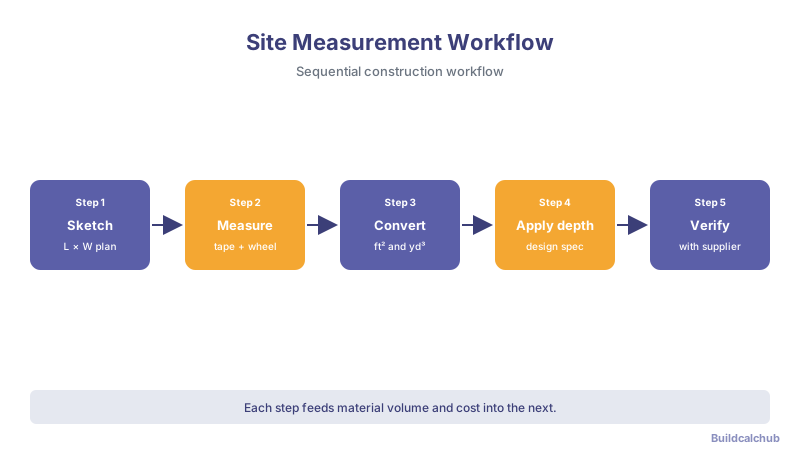
Measuring Real Spaces Accurately
- Walk the space — identify all corners, alcoves, curves, level changes. Draw a rough sketch.
- Measure with the right tool:
- Short distances: tape measure (accurate to 1/16 in)
- Long distances: laser measure (accurate to 1/8 in at any distance)
- Elevations: level + rod, or laser level
- Property boundaries: survey or GPS (professional)
- Measure twice — critical dimensions (foundation walls, room widths). Tolerable errors are ±1%.
- Note wall thickness — interior room measurements vs. exterior ‘outside-to-outside’ differ by 8-12 inches per exterior wall.
- Convert to consistent units — all feet (with decimal inches) or all meters before calculating.
- Check the math — area and volume often show calculation errors. Roughly: total = sum of parts.
When grades drive material depth or drainage direction, use the slope percentage guide with the Slope Calculator before ordering base or surface material.
For digging and backfill jobs, the excavation safety and shrink-swell guide explains why bank volume, loose volume, and compacted volume should not be treated as the same number.
Real-World Example Calculations
Full Home Measurement for Flooring
Measuring an entire 1,800 ft² house for hardwood flooring throughout living areas.
- Living room
- 16 × 20 = 320 ft²
- Kitchen
- 14 × 16 = 224 ft²
- Dining
- 12 × 14 = 168 ft²
- Hallway
- 3 × 20 = 60 ft²
- Master bedroom
- 14 × 16 = 224 ft²
- Bedroom 2
- 12 × 14 = 168 ft²
Takeaway: Standard approach: measure each room separately. Add 10-15% for herringbone or diagonal patterns. Bathrooms typically tile, not hardwood.
How Measurement Errors Become Cost Overruns (2026)
Construction material costs have risen 8–15% annually since 2021, making accurate measurement more important than ever. A 5% measurement error on a $20,000 material project = $1,000 in wasted material or emergency reorder costs.
| Year | Avg residential material spend | 5% measurement-error cost | Emergency reorder premium |
|---|---|---|---|
| 2024 | $16,000–$22,000 | $800–$1,100 | +25–40% |
| 2025 | $17,500–$24,500 | $875–$1,225 | +30–45% |
| 2026 | $19,000–$27,000 | $950–$1,350 | +35–50% |
Common estimation errors and their cost impact:
- Treating irregular rooms as rectangles — typical 5-10% over-estimate, $500-2,000 per project
- Forgetting to add waste factor — 10% shortfall forces 2nd trip at 1.5× original pricing
- Incorrect unit conversion — yards confused with feet; can result in 3× or 1/3× orders
- Not accounting for soil swell — leaves 25% of excavation volume unplanned for disposal
- Missing slope calculation — drainage failure costs $2,000-5,000 in remediation
Spending an extra 30 minutes on careful measurement saves an average of $300-800 on a typical $5,000 material project.
For material ordering, the most common unit mistake is confusing volume with weight. Use the cubic yards vs tons guide before converting aggregate, asphalt, sand, or soil estimates.
Regional Code & Accessibility Variations
Measurement is supposed to be universal — a foot is a foot and a degree is a degree. What varies is what the measured number is compared against. ADA ramps, driveway slopes, footing depths, fence setbacks, and property line clearances all have regional interpretations that change the answer. Over my 15 years of practice I've learned that the measurement is easy; the code overlay is where projects get delayed.
Frost-line depth by state (affects footing, excavation, post-depth measurements)
Frost depth is the single most important regional variable in construction measurement. The IRC gives a baseline but state amendments override:
- Florida, south Texas, southern CA, Hawaii: 12 in required (practically frost-free, code minimum)
- Carolinas, Tennessee, most of Virginia: 12 to 18 in required, 18 is typical
- Delaware (my home state), Maryland, NJ, eastern PA: 30 in required, 36 in recommended
- Ohio, Indiana, Illinois, Iowa: 36 to 42 in required
- Pennsylvania mountains, upstate NY, VT, NH, Maine: 42 to 48 in required
- Minnesota, Wisconsin, North Dakota, Montana north: 48 to 60 in required
I keep a laminated sheet of state frost depths in my truck. The number determines whether a fence post goes 30 in or 54 in, and that changes the concrete quantity and the cost by 2 to 3x.
ADA vs state accessibility standards (affects ramp and walkway slope)
Federal ADA (ADA Standards for Accessible Design 2010) sets maximum ramp slope at 1:12 (8.33%) with handrails on runs over 6 in rise. But several states have stricter overlays:
- California (Title 24, CBC Chapter 11B): 1:20 (5%) preferred for paths of travel; 1:12 maximum on ramps with additional landing requirements
- Texas (TAS, enforced by TDLR): substantially parallel to ADA but with explicit enforcement by a different agency
- Massachusetts (521 CMR): stricter handrail and landing requirements than federal ADA
- New York State code: 1:12 maximum with 2% cross slope max on paths of travel
I've had two projects where a homeowner's existing walkway met ADA federal spec but failed state spec because the cross-slope was 3% instead of the 2% California limit. A $14,000 walkway replacement resulted from a 1% slope delta that survey-grade measurement would have caught.
Driveway and parking slope limits by jurisdiction
Residential driveways typically get 14 to 18% slope limits on private property, but municipalities vary. San Francisco famously allows 31% on residential streets (the steepest in the US). In contrast, Dover DE (where I'm based) limits private driveway apron slope to 10% at the sidewalk and 5% at the property line for drainage reasons. Parking lots under ADA: 2% maximum in all directions for accessible spaces.
Area measurement for setbacks and zoning
The way you measure a lot for setback compliance is not always "the short way." Some jurisdictions measure from the foundation edge; some from the eave line; some from a projected roof overhang. I had a deck permit denied in 2023 because I had measured to the deck post base, but the municipality measured to the deck edge projection. The project needed a 6 in redesign. When measuring for setback, always confirm which feature the local code measures to.
What Bad Measurements Actually Cost (2026 examples)
I've pulled these examples from actual project reviews on my consulting calendar in the last 18 months. Every one is a real measurement failure with a real dollar cost.
| Project | Measurement Error | Cost Impact | How it could have been prevented |
|---|---|---|---|
| Residential driveway, PA | Slope distance used as horizontal for a 120 ft drive on 18% grade | $2,400 in excess asphalt | Laser level + horizontal dimension check |
| Retaining wall, VA | Face feet measured along curve instead of chord; block count 11% short | $1,350 remobilization + emergency stone delivery | Measure the chord, add curve allowance separately |
| Paver patio, MD | Area formula used rectangle for a trapezoid shape; 18% material shortfall | $2,200 in partial-pallet paver fee + 3-week delay | Break into rectangles and triangles; sum |
| Deck, NJ | Setback measured from post base; code required measurement from edge projection | $4,100 redesign + permit re-submission | Confirm setback measurement basis with zoning before design |
| Concrete slab, DE | Used 9 ft³/yd³ instead of 27 ft³/yd³ conversion; ordered 3x mix | $3,800 for excess concrete disposal | Memorize 27 ft³/yd³. Always. |
| Asphalt parking lot, PA | Tape measured 198 ft on what was actually a 191 ft run; 3.6% tonnage error | $940 excess material cost | Laser or wheel for runs over 50 ft |
| Gravel driveway, MN | Ordered loose cubic yards when quote was in compacted cubic yards; 20% short | $680 second delivery trip charge | Clarify the yard type (loose vs compacted) with supplier |
Calibration and verification I actually do on a job
Before I mark a dimension as "ready to price," I run through these checks. They take 10 to 20 minutes and save multiples of that in remedial work:
- Measure twice with different instruments. Tape and wheel, or laser and wheel. If they disagree by more than 0.5%, find out why before proceeding.
- Square the corners with a 3-4-5 triangle. For any patio or foundation, verify the layout is actually square. An out-of-square 20 x 15 rectangle can be 2 to 4 in off on the diagonal, which compounds into material waste.
- Sanity-check the volume in two unit systems. Calculate in ft³, convert to yd³, and cross-check with the direct yd³ computation. If they match within 0.1%, you have the conversion right.
- Photograph the measurement setup. A phone picture of the tape laid out, the dimensional markers, and the end references gives you a record if the contractor questions the measurements later.
- Write dimensions on the site plan before ordering. Every project gets a sketch on a clipboard with dimensions and volume callouts. Orders are placed against the sketch, not against memory.
Every calculator on this site works on dimensions you provide. If your dimensions are off, the calculation is off. Use the area calculator for irregular shapes, slope calculator for vertical distances, and cubic yard calculator for material volume. Check twice before you buy.
The conversion constants I keep memorized
After 15 years I rarely pull out a reference for these. Memorizing them has saved me from dozens of field errors:
- 27 ft³ = 1 yd³. The single most-used conversion in construction. Not 9, never 9.
- 1,728 in³ = 1 ft³ (12 cubed). Used when converting small pour volumes from inches to feet.
- 1 ton = 2,000 lb US short ton. Metric tonne is 2,204 lb; know which one the supplier quotes.
- 1 yd³ of compacted hot-mix asphalt ≈ 1.96 tons at 145 lb/ft³ standard density.
- 1 yd³ of dry topsoil ≈ 1.35 tons at 100 lb/ft³; wet topsoil runs closer to 1.5 tons.
- 1 yd³ of crushed stone ≈ 1.4 tons for limestone at 105 lb/ft³ loose, 1.55 tons compacted.
- 1 yd³ of concrete ≈ 4,050 lb at 150 lb/ft³. Useful for load checks on trucks and axle limits.
- Slope: 1% = 0.573 degrees = 0.12 in per ft. 8.33% = the ADA ramp maximum = 1:12 = 1 in per ft.
- Circle area ≈ 3.14 × r². Exterior diameter measurements divide by 2 first. I've seen contractors multiply, which gives a 4x error.
- Board feet: length (ft) × width (in) × thickness (in) ÷ 12. A 2×8 × 12 ft is 12 board feet, not 24.
These conversions live on an index card in the glove box of my truck because the one day I forget is the day I need them for a $4,000 order.
Engineering References
These references are used for terminology, safety boundaries, and engineering assumptions. Local code, supplier specifications, and licensed design documents still control your project.
-
OSHA Trenching and Excavation Safety
Occupational Safety and Health Administration
Referenced for excavation safety, protective systems, and worker-safety boundaries.
-
ADA Standards for Accessible Design
U.S. Department of Justice
Referenced for accessible slope and route guidance.
-
NRCS Soil Health and Soil Survey Resources
USDA Natural Resources Conservation Service
Referenced for soil classification, shrink-swell behavior, and site variability.
-
FHWA Geotechnical Engineering Program
Federal Highway Administration
Referenced for subgrade, compaction, and soil support concepts.
-
NIST SP 811: Guide for the Use of the International System of Units (SI)
National Institute of Standards and Technology
Referenced for length, area, and volume conversion constants used in this calculator suite.
-
ICC Digital Codes — IRC R403 (Footings & Frost Depth)
International Code Council
Referenced for state-by-state frost-depth and footing-bearing requirements used in the field-mistakes and regional-codes sections.
-
American Wood Council Span Tables & DCA-6
American Wood Council
Referenced for nominal-vs-actual lumber dimensions and joist span data.
Frequently Asked Questions
How do I measure a room's square footage?
Measure length and width in feet (convert inches by dividing by 12). Multiply: L × W = square feet. For irregular rooms, decompose into rectangles, calculate each, sum. Use a laser measure for distances over 15 ft.
How do I convert square feet to cubic yards?
Square feet is area; cubic yards is volume. You need a depth: Cubic yards = (ft² × depth in ft) ÷ 27. At 4 in depth: ft² ÷ 81 = yd³. A 500 ft² patio at 4 in = 6.17 yd³.
What's the most accurate way to measure?
For construction estimates, use a laser distance meter ($25-45). Accurate to 1/8 inch at any distance, much better than tape measures beyond 10-15 feet. For elevations, use a laser level with grade rod or a smartphone inclinometer app.
How many feet in a yard?
3 feet per yard. 1 square yard = 9 square feet (3×3). 1 cubic yard = 27 cubic feet (3×3×3). Essential conversions for flooring, fabric, and bulk material purchasing.
How do I calculate area of a triangle?
A = (base × height) ÷ 2. Base and height must be perpendicular. For triangles where you know only the 3 sides, use Heron's formula: s = (a+b+c)/2, then A = √(s(s-a)(s-b)(s-c)).
What's the difference between slope and grade?
Essentially the same thing. Slope is a general geometric term; grade is the civil engineering term, typically expressed as percent (2% grade = 2% slope). A ‘grade’ or ‘pitch’ more commonly refers to long-distance slopes (roads, driveways) while ‘slope’ is used for shorter distances (patios, ramps).
How precise do construction measurements need to be?
For material estimates: ±2-3% (typically 1/8 inch on room measurements). For framing and foundations: ±1/4 inch (0.5%). For finish work (cabinetry, trim): ±1/16 inch. For property boundaries: professional survey (±0.01 ft).