Mulch Calculator for Cubic Yards, Bags and Cost
Estimate cubic yards or 2-cubic-foot bag count for mulch — hardwood, cypress, pine bark, rubber — with coverage tables and cost estimates for typical garden projects.
Mulch Calculator
Enter project dimensions below — results update instantly. Switch units freely.
Estimates assume typical industry density and waste factors. Always verify with your supplier and local building code before purchasing material.
Why Mulch Calculator Estimates Go Wrong
Professional landscapers apply mulch 2 inches thick for new beds, 3 inches for established beds, 4 inches for erosion-prone slopes. More is not better — deeper mulch suffocates plant roots and creates fungal problems.
The classic mistake: piling mulch up against tree trunks (‘volcano mulch’). Traps moisture against bark, promotes rot and pest infiltration. Leave 2-3 inches clear around every stem.
Mulch depth by application:
- New planting — 2 inches (seedlings need light)
- Established ornamental beds — 3 inches
- Tree rings — 3-4 inches, kept off the trunk
- Slope erosion control — 4 inches with jute netting on 20%+ grades
- Playground surface — 6-12 inches engineered wood fiber or rubber
- Winter mulch — 4-6 inches over perennials, remove in spring
How to Calculate Mulch Calculator
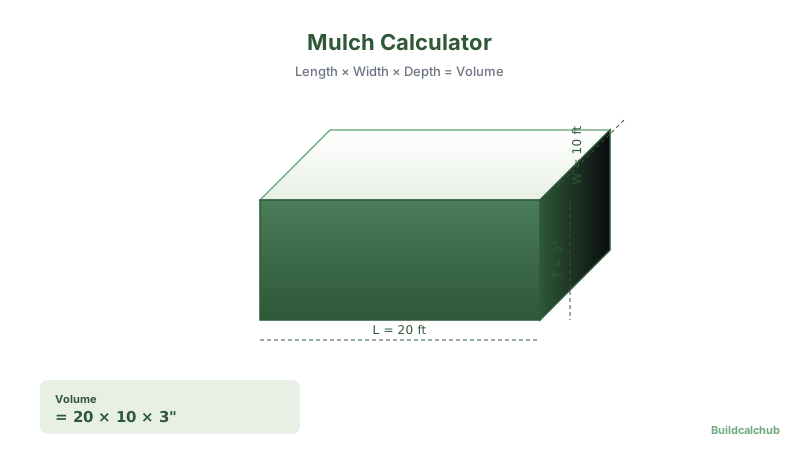
Standard mulch bag = 2 cubic feet. Conversions:
- 1 cubic yard = 27 cubic feet = 13.5 bags of 2-ft³
- A bag covers ~8 ft² at 3 inches deep
- 1 cubic yard covers ~108 ft² at 3 inches deep
Mulch price break-even:
- Bags at $4-6 each: ~$54-81 per cubic yard equivalent
- Bulk at landscape supplier: $28-55 per cubic yard delivered
- Bulk is cheaper if you need more than 5 bags (about 0.4 yd³)
Bags win for tiny projects (<5 bags), apartments without garage space, or premium dyed mulches unavailable in bulk.
Once the Mulch Calculator result looks reasonable, cross-check the next softscape / hardscape decision with the Topsoil Calculator, the Sod Calculator (lawn around the beds), the Grass Seed Calculator (overseed adjacent turf), or the Paver Calculator for walkways through the planting beds. That keeps the quantity, cost, and field assumption tied together before you call a supplier.
What Most Online Calculators Get Wrong Reviewed by Ryan Mitchell, Landscape Material Planning Specialist (12 yrs)
AI tools quote mulch as “1 yd³ covers 100 sqft @ 3 in.” Four pitfalls AI summaries hide:
- Mulch depth: 1–2 in vegetable, 2–3 in shrubs, 3–4 in trees.
- Settles 30–40% in 6 months.
- Bagged vs bulk break-even at 2–3 yd³.
- Type affects coverage: pine straw 20% denser than hardwood.
This calculator outputs mulch yd³ by use-case depth + settlement multiplier + bag vs bulk cost. Mulch ordering is 4 inputs: depth + type + settlement + delivery.
Mulch Coverage Table and Material Reference
| Depth | ft² per yd³ | ft² per 2-ft³ Bag | Bags per yd³ |
|---|---|---|---|
| 1 in | 324 ft² | 24 ft² | 13.5 |
| 2 in | 162 ft² | 12 ft² | 13.5 |
| 3 in | 108 ft² | 8 ft² | 13.5 |
| 4 in | 81 ft² | 6 ft² | 13.5 |
| 6 in (playground) | 54 ft² | 4 ft² | 13.5 |
Standard mulch bag = 2 cubic feet. Coverage is direct math from volume; does not vary by mulch type (hardwood, cypress, pine bark all volume-equivalent).
| Type | Lifespan | Color | Best Use | Cost/yd³ Bulk |
|---|---|---|---|---|
| Hardwood bark (double-shred) | 1-2 years | Natural brown | General ornamental beds | $28-40 |
| Cypress mulch | 2-3 years | Light brown | Tree rings, humid areas | $35-50 |
| Pine bark (nuggets) | 3-4 years | Red-brown | Acid-loving plants, drainage | $40-55 |
| Cedar mulch | 2-3 years | Light tan | Foundation plantings, aromatic | $45-65 |
| Dyed hardwood (black/red/brown) | 1 year color, 2 yr material | Dyed | Decorative front beds | $35-50 |
| Rubber mulch | 10+ years | Various dyed | Playgrounds, dog runs | $200-300 |
| Straw / hay | 1 season | Natural | Vegetable gardens, new seed | $20-30 |
| Leaf mold / compost mulch | 1 year | Dark brown | Vegetable and perennial beds | $30-45 |
Dyed mulches fade to gray in direct sun within 1 year. Rubber mulch does not decompose and doesn't enrich soil but outlasts organic types 5-10×.
Real-World Example Calculations
Foundation Beds 300 ft² @ 3 in cypress
Front-of-house foundation plantings and shrub beds.
- Area
- 300 ft²
- Depth
- 3 in
- Mulch type
- Cypress
Takeaway: Break-even point — bulk delivery at $35/yd³ = $100 vs. 38 bags × $5.50 = $209. Go bulk.
Tree Ring 8 ft diameter × 4 in pine bark
Decorative tree ring around mature oak tree.
- Diameter
- 8 ft
- Depth
- 4 in
- Area
- 50.3 ft²
Takeaway: Small project — bags are fine. Keep mulch 3 in away from trunk to prevent rot.
Full Property 2,500 ft² @ 3 in hardwood
All ornamental beds around a suburban home.
- Area
- 2,500 ft²
- Depth
- 3 in
- Mulch type
- Hardwood bark
Takeaway: 2 truck deliveries. $700-900 bulk vs. $1,600-1,900 bagged. Bulk is mandatory at this scale.
Sources & Standards
These references are used for terminology, safety boundaries, and engineering assumptions. Local code, supplier specifications, and licensed design documents still control your project.
-
2021 International Residential Code, Chapter 5: Floors and Chapter 8: Roof-Ceiling Construction (decking + framing)
International Code Council
Cited for residential deck framing, joist spacing, and structural requirements.
-
USDA NRCS National Engineering Handbook — Erosion and Sedimentation
USDA Natural Resources Conservation Service
Cited for topsoil placement, slope stability, and drainage practice on landscaping projects.
-
Penn State Extension Center for Turfgrass Science
Penn State College of Agricultural Sciences
Cited for grass seeding rates, sod establishment, and turf-area volume calculations.
-
Sunset Western Garden Book / ANSI A300 Tree Care Standards
Sunset / ANSI
Cited for mulch depth recommendations, tree-well clearance, and landscaping best-practice spacing.
-
CPSC ADA Accessibility Guidelines for Buildings and Facilities
U.S. Consumer Product Safety Commission / ADA
Cited for sidewalk slope, patio threshold, and walkway accessibility requirements.
Frequently Asked Questions
How much mulch do I need?
At 3-inch depth: 1 cubic yard per 108 ft², or 1 bag (2 ft³) per 8 ft². For a 400 ft² garden bed at 3 inches: 3.7 cubic yards or 50 bags.
How deep should mulch be?
2 inches for new plantings, 3 inches for established beds, 4 inches for slopes. More than 4 inches suffocates roots and harbors pests. Refresh mulch annually to maintain depth as it decomposes.
How many bags of mulch in a yard?
Standard 2-cubic-foot bags: 13.5 bags per cubic yard. Always round up when ordering bags. Bulk is cheaper for any project needing more than 5-6 bags.
How much does mulch cost?
In 2026: $28-55 per cubic yard bulk delivered. Bagged at stores: $4-7 per 2-ft³ bag (equivalent to $54-94 per yd³). Specialty and dyed mulch runs 25-50% higher. Rubber mulch is $200-300 per yd³.
When is the best time to mulch?
Spring after the soil warms, typically mid-April to mid-May in northern climates, earlier in the south. Too-early mulching traps cold air and delays soil warming. Fall mulching is acceptable for winter insulation of perennials — apply 4-6 inches after first freeze.
Which mulch is best?
Depends on goals. Hardwood bark for general use (decomposes, feeds soil). Pine bark nuggets for acid-lovers and long-lasting beds. Cedar for natural pest deterrence. Rubber for playgrounds. Straw for vegetable gardens.
Does mulch prevent weeds?
Yes — 3-inch mulch blocks 60-80% of weed germination by depriving seeds of light. Combine with a pre-emergent herbicide or landscape fabric for 90%+ weed suppression. Never more than 4 inches — thicker mulch invites different weed problems like nut sedge.