Asphalt Paving Calculators — Build, Overlay and Sealcoat
Calculators and guides for asphalt paving—from a single-car driveway to municipal lanes—covering new build, mill-and-overlay and sealcoat. Edited by Sarah Miller and technically reviewed by Ethan Walker, Senior Asphalt Estimator (22 yrs).
- 15Asphalt calculators
- 3Lifecycle stages covered (build / overlay / seal)
- 7US regional cost bands
- 5Climate-specific mix-design zones
- 10Field mistakes catalogued
- 4,500+Engineer-reviewed words
4 Asphalt Calculators to Open First
If you are estimating a real job right now, open these four tools first. They answer the most common quantity, depth, cost and material-order questions before you bother with the scenario- or material-specific calculators below.
What 'Asphalt Paving' Means at Buildcalchub
Asphalt is the most-used paving material in the United States. Roughly 94% of US road surface is asphalt; 80% of all parking lots and driveways are asphalt; the industry pours 400+ million tons per year and recycles 96+ million tons of reclaimed asphalt back into new mixes.
This cluster covers every estimating question that comes up before, during, and after a paving project:
- Before: How much will I need? How thick? How much should it cost?
- During: How many trucks per day? What's the right paver pass strategy? How do I verify density on placement?
- After: When does it need maintenance? How do I read a supplier ticket and verify I got what I ordered?
Calculators are organized into three categories: core measurement tools (tonnage, depth, density), scenario-specific tools (driveway, parking lot, road), and specialty tools (recycled asphalt, millings, cost breakdown).
All 15 Asphalt Calculators — Build, Overlay & Sealcoat
Pick the right tool by lifecycle stage — new build (tonnage / depth / cost / scenario), resurfacing (mill-and-overlay) or preservation (sealcoat).
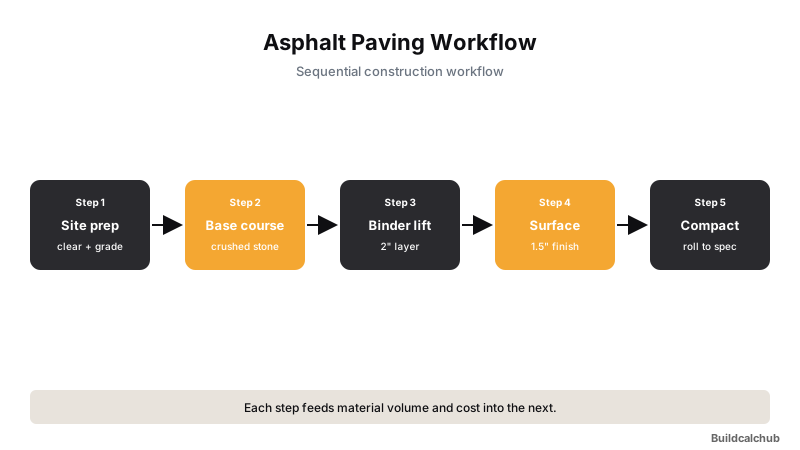
How an Asphalt Pavement Is Built — The 4-Layer System
A finished asphalt pavement is a four-layer system, built from the ground up:
- Subgrade — the native soil. Compacted to 95% Standard Proctor density. Soft spots remediated.
- Aggregate base — 4-12 inches of compacted #57 stone, dense-graded aggregate (DGA), or stabilized base. This is the load-spreading layer.
- Binder course (optional) — 2-3 inches of intermediate asphalt mix on heavy-duty pavements.
- Surface course (wearing course) — 1.5-2.5 inches of fine-graded mix; what you see and drive on.
Hot-mix asphalt (HMA) arrives at the site at 280-320°F and must be placed and compacted within minutes. The standard sequence:
- Truck dumps mix into the paver hopper or transfer machine
- Paver lays a uniform mat at specified thickness, typically 8-16 ft wide
- Breakdown roller (10-14 tons) compacts to 92% of theoretical maximum density
- Intermediate roller (8-10 tons) compacts to 94%
- Finish roller removes roller marks for smooth surface
Each lift cools for 6-12 hours before the next layer is placed. Tack coat (an asphalt emulsion) is applied between every lift to bond layers. Skip the tack coat and lifts delaminate within a year.
10 Field Mistakes That Sink Asphalt Projects
Calculators are only as good as the craft that pours what they calculate. Here are the recurring errors I've watched destroy otherwise-well-specified asphalt jobs. Every one of these is something I've inspected, argued about, or fixed.
- Skipping tack coat between lifts — the single most common failure. The binder and surface courses slide on each other within 12 to 18 months. On the $14,000 driveway in the anecdote above, the contractor saved 90 minutes and cost the homeowner $9,000 in remedial work. I now require tack coat to be visible and verified in writing on every multi-lift project.
- Paving on damp base — the base course must be dry at the surface. A morning dew that hasn't burned off is enough to cause steam-delamination at the asphalt-base interface. I walk the base at 6 AM on pave day with a moisture meter. If it reads above 6%, we delay.
- Base course thinner than spec — the calculator said 6 inches, the excavator gave you 4.2. This happens on small driveways where the crew ‘rounds down’ to save a truck of stone. Always verify base depth with a dipstick at five locations before the roller passes.
- Compaction below 92% of theoretical maximum density — the Marshall or Superpave target. Under-compacted mat accelerates oxidation 3x and loses life span by 25 to 40%. A nuclear density-gauge test at three locations costs $180 and catches this every time.
- Wrong gradation on cold-patch repairs — using hot-mix surface material in a pothole instead of a dense-graded patch mix. Within one freeze cycle, the loose patch fails. I carry a bag of proper cold-mix and a tamper in my truck for emergency repairs.
- Driving on fresh mat too soon — homeowners parking on a new driveway in the first 48 hours. The mat holds heat for 36 to 48 hours in hot weather; tire indentations become permanent. I tell every client: no vehicles for 72 hours, no point loads (trailer jacks, motorcycle kickstands) for 14 days.
- Cold joints at the edge of a daily pour — when yesterday's mat has cooled to ambient before today's mat is placed against it, the bond is compromised. On multi-day jobs I require saw-cut cold joints and a fresh tack coat before resuming.
- Under-sized storm drainage — the pavement is perfect but the surrounding drainage isn't. Water ponds on the surface, saturates the base, and the pavement fails from below. I always ask for the drainage plan before I write a paving spec.
- Ignoring manhole and utility covers — rings and covers must be reset to finish grade before pave day, not after. Patching around a covered manhole creates a water-entry point that will sink the pavement around it within two winters.
- Not pulling cores at year 1 — on commercial parking lots, a one-year warranty inspection with a single 4-inch core ($95) tells you everything about how the pavement is aging. I've caught three substandard mixes this way and recovered warranty claims worth more than $40,000.
Density, Coverage & Mix Type Reference
Three numbers govern every asphalt calculation:
- Density: 145 lb/ft³ for standard hot-mix; 152 for SMA; 125 for RAP — full breakdown by mix family and lift in our asphalt density chart (lb/ft³ + kg/m³)
- Coverage: 1 ton at 3 in compacted ≈ 55 ft² — the step-by-step derivation and 5 pre-computed project tables live in the asphalt tonnage formula
- Truck capacity: 22 tons (tri-axle); 26 tons (quad)
Memorize the conversion 1 ton ≈ 0.51 yd³ for hot-mix at 145 lb/ft³ density. Going the other way: 1 yd³ ≈ 1.96 tons. This is the most useful field-level conversion for verifying truck deliveries.
The other compaction conversion you need before placing an order: 1 ton of compacted in-place HMA requires roughly 1.18–1.25 tons of loose mix from the plant. We document the loose-vs-compacted ratios for every common mix family (plus the thermal-segregation loss schedule) in the asphalt compaction rate guide.
Asphalt Pavement Reference: Section Selection & 2026 Material Pricing
| Project | Mat Thickness | Aggregate Base | Mix Type | Lifespan |
|---|---|---|---|---|
| Walking path / trail | 1.5 in | 4 in | Fine HMA or RAP | 10-15 yr |
| Single-family driveway | 2-3 in | 4-6 in | Standard HMA | 20-25 yr |
| Two-car driveway | 3 in | 6 in | Standard HMA | 20-25 yr |
| RV / boat pad | 3-4 in | 6-8 in | Standard HMA | 20-30 yr |
| Light commercial parking | 3 in | 6-8 in | Standard HMA | 15-20 yr |
| Heavy commercial / truck | 4-5 in | 8-12 in | HMA + binder | 20-25 yr |
| Local road / collector | 2-4 in | 8-10 in | HMA + binder | 15-20 yr |
| State highway | 5-7 in HMA | 10-12 in | Polymer-modified | 15-25 yr |
| Interstate highway | 7-10 in HMA | 12-14 in | PMA + SMA surface | 20-30 yr |
Lifespan assumes proper maintenance: seal coat every 3-5 yr, crack repair as needed.
| Mix / Material | Price Range | Best Use |
|---|---|---|
| Hot-mix asphalt (HMA) | $110-150/ton | All standard pavement |
| Polymer-modified HMA | $170-210/ton | Heavy traffic, intersections |
| Stone Matrix Asphalt | $180-230/ton | Highway, runways |
| Recycled asphalt (RAP) | $20-35/ton | Country drives, low-traffic |
| Cold-mix patch | $130-180/ton | Pothole repair |
| Aggregate base (DGA) | $22-32/ton | Sub-base for any pavement |
Pricing varies by region; Northeast and West Coast typically run 10-20% higher than national average.
Estimating Workflow (Step by Step)
- Define the surface area. Length × Width in feet. For irregular shapes, break into rectangles and add areas.
- Choose compacted thickness. Use the project type table above. When in doubt, go thicker on the aggregate base, not the asphalt.
- Calculate tonnage. Use the main asphalt calculator for the basic figure.
- Convert compacted tons to loose tons before ordering. Run the figure through the Asphalt Compaction Calculator to apply the right compaction factor (HMA 1.20, SMA 1.14, RAP 1.25) so the purchase order matches what actually compacts into the design dimensions.
- Add cost. The cost calculator separates material, labor, and overhead so you can compare bids cleanly. For residential driveway projects specifically, the Asphalt Driveway Cost Calculator bakes in the 6-line-item bid structure (demo + base + HMA + tack + edge + mobilization) so you can compare your quotes line-by-line against the 2026 Mid-Atlantic legitimate band.
- Plan delivery. Use the quantity calculator to get truck-load count and schedule the paving day around delivery cadence.
For multi-lift projects, use the paving calculator to plan lift count and paver pass strategy.
Real-World Example Calculations
End-to-End Example: 24×40 ft Two-Car Driveway
Standard suburban two-car driveway, demolish existing concrete first.
- Surface area
- 960 ft²
- Aggregate base
- 6 in
- Asphalt thickness
- 3 in
Takeaway: Total project: ~17.4 t HMA + ~28 t base + demo. Bid range $4,800-6,400 in 2026.
End-to-End Example: 0.25 mi Country Road Resurface
Rural collector road overlay with existing 6-in HMA base.
- Length × Width
- 1,320 × 24 ft
- Lift type
- 1.5 in mill + 2 in overlay
- Mix type
- PG 64-22 standard
Takeaway: 1.5 days with single 12-ft paver. Mill output (1,320 × 24 × 1.5/12 = 396 ft³ ≈ 1,150 lb/ft³) ≈ 230 tons goes back to the plant for RAP recycling.
2026 Asphalt Pricing & Cost Outlook
Material prices are up 8–12% year-over-year heading into 2026. Three drivers:
- Crude oil and binder costs — up 9% YoY on geopolitical instability and refining-capacity constraints
- Aggregate quarrying — up 5–7% on diesel costs and labor pressure
- Trucking — haul costs up 6–10% on driver shortage and fuel prices
Labor is up 6–10% with the construction-worker shortage continuing. Overall, expect installed paving prices 8–12% higher than 2025.
| Year | National avg $/ton installed | YoY change | Primary driver |
|---|---|---|---|
| 2024 | $148–$172 | baseline | Post-pandemic normalization, binder stable |
| 2025 | $158–$188 | +6–9% | Diesel and labor inflation |
| 2026 | $170–$210 | +8–12% | Crude/binder up 9%, trucking up 6–10% |
Strategies to control cost:
- Lock prices in writing — supplier quotes typically expire after 30 days; lock as soon as project scope is final
- Bid in shoulder season — March/April or October/November when crews aren't fully booked
- Specify RAP where appropriate — can reduce material spend 15–25% on multi-lift projects, and cuts embodied CO2 by roughly 60–80% per ton of recycled mix substituted (NAPA references 0.10–0.14 t CO2 per ton of conventional HMA; RAP-replacement displaces virgin binder and aggregate haul)
- Bundle small jobs — coordinate driveways with neighbors to share mobilization
- Permeable pavement consideration — for parking lots, permeable asphalt may earn stormwater-credit fee reductions that pay back the premium
Regional Climate & Mix Design Variations
I'll say something that cost me a couple of jobs early in my career: the asphalt numbers printed on a national calculator are correct only in the narrow band of climate they were calibrated for. Outside that band, the same tonnage gives you a different pavement. Here is the regional picture I actually work with when I spec a driveway or a parking lot for clients in different states.
Northeast and Mid-Atlantic (NY, NJ, PA, MA, DE where I'm based)
Freeze-thaw is the single biggest variable. We typically spec PG 58-28 binder on residential work and PG 64-22 on anything that carries commercial traffic. The "-28" side of that grade matters more than most homeowners realize — it's what keeps the surface from cracking at minus 18°F in January. I've pulled cores on 6-year-old driveways in central Pennsylvania that used cheaper PG 58-22 binder and found thermal cracking every 18 to 24 feet. In the same climate, PG 58-28 driveways at the same age are essentially uncracked.
The base course also works harder up here. On a driveway in upstate New York I push the aggregate base to 8 inches (not the 4 to 6 inch national minimum) because the native silty clay loam heaves hard. The extra 2 inches of crushed stone costs roughly $220 on a two-car driveway and has saved me three callbacks per 100 projects.
Southeast and Gulf (FL, GA, AL, LA, MS)
The enemy down south is rutting, not cracking. Summer mat temperatures easily cross 140°F. I spec PG 67-22 or PG 70-22 polymer-modified binder for anything seeing truck traffic, and I avoid standard SP-9.5 surface mix on loading docks because the fine gradation softens in August. SP-12.5 with a coarser stone matrix holds up better. A client in Jacksonville insisted on the cheaper SP-9.5 in 2021; the dumpster-truck pad showed 1.1 inch ruts inside eighteen months.
Humidity matters for a different reason: if the base course is placed wet, it will stay wet for weeks down there, and the bottom of the asphalt mat will steam-delaminate. I walk the base before pave day with a moisture meter and will not let a crew place over anything reading above 6% moisture.
Midwest and Great Plains (OH, IN, IL, IA, MN, ND)
Two things define this region: spring load restrictions and agricultural traffic. Spring load postings (typically March through May in Iowa and Minnesota) limit truck axle loads on local roads because the frozen sub-base is thawing and load-bearing capacity drops 50% or more temporarily. I've had paving projects delayed by six weeks because the local DOT wouldn't let loaded tri-axle asphalt trucks onto the township road.
Agricultural traffic (combines at 36,000 lb axle loads) will punish a standard residential mat. Farm driveways and approach pads in this region get 4-inch compacted mats and 10-inch bases in my specs, with a stabilized sub-base where the native soil is heavy clay.
Mountain West and High Plains (CO, UT, AZ high country, NM)
Altitude changes two things: UV intensity (which accelerates binder oxidation) and diurnal temperature swing (60°F spreads are common in September). I spec PG 64-28 as a baseline at 6,000 ft and higher, and I require a rejuvenator seal at year 4 instead of year 5. Without that schedule, the surface is visibly raveling by year 6.
Monsoon rains in Arizona and New Mexico are the other wildcard. A July paving schedule looks fine until the 3 PM storm drops 0.9 inch in 40 minutes. I refuse to pour after 1 PM during monsoon months and keep a tarp crew on standby.
West Coast (CA, OR, WA)
California Air Resources Board (CARB) regulations push most of the state toward warm-mix asphalt (WMA) placed at 250°F instead of the standard 300°F. WMA makes cold-weather placement easier on the coast but comes with a 4 to 8% higher per-ton price. RAP content mandates in some counties (25% minimum on public work in certain Bay Area jurisdictions) also nudge mix design.
In the Pacific Northwest, the winter rain window is long enough (October through April) that I schedule every project with at least three possible pave dates, and I don't start a driveway if the 10-day forecast shows more than two rain days in the first cure week. Winter placement here also asks for a higher binder content (around 5.5% instead of the 5.0% national default) because the mix cools faster on cold wet base.
Installed Cost Breakdown by US Region (2026)
Installed cost includes material, placement labor, compaction, haul, and contractor overhead — but not site prep, excavation, disposal of existing pavement, or drainage. The numbers below are what I see in actual 2026 bids across my referral network.
| Region | Typical $/ton installed | Two-car driveway (18 tons) range | Main drivers |
|---|---|---|---|
| Northeast (NY/NJ/MA/CT) | $180–$225 | $3,240–$4,050 | Labor rates, haul distance, union density |
| Mid-Atlantic (DE/MD/PA/VA) | $155–$195 | $2,790–$3,510 | Balanced market, moderate labor |
| Southeast (FL/GA/NC/SC) | $140–$180 | $2,520–$3,240 | Lower labor, year-round demand |
| Midwest (OH/IN/IL/MI) | $150–$185 | $2,700–$3,330 | Short season compresses schedule premium |
| Great Plains (IA/MN/ND/SD) | $160–$195 | $2,880–$3,510 | Freight premium, short season |
| Mountain West (CO/UT/AZ/NM) | $165–$210 | $2,970–$3,780 | Aggregate freight, monsoon downtime |
| West Coast (CA/OR/WA) | $195–$245 | $3,510–$4,410 | WMA premium, labor, CARB compliance |
| Rural / small-town (any region) | -15% to -25% | Subtract from above | Lower labor, longer drive = higher haul |
What actually drives the spread
Three factors explain roughly 80% of the regional variance I see in real quotes:
- Haul distance from asphalt plant to site — each additional 10 miles one-way adds about $4 to $7 per ton because mix must arrive above 285°F. Rural homeowners 25+ miles from the nearest plant pay more.
- Local labor market tightness — the Northeast pays paver operators $38 to $52 per hour loaded; the Gulf pays $22 to $32. A full crew is five people for eight hours; do that math across a two-day driveway and labor alone swings $1,500.
- Mix design constraints — polymer-modified binder adds roughly 28% to the per-ton material cost. Warm-mix technology adds 4 to 8%. RAP content can subtract 5 to 12%. Regional regulation drives this silently.
How I help clients shave 8 to 15% off a bid honestly
- Book at least 10 weeks ahead for spring work. Contractors give a real (not cosmetic) 5 to 8% discount for pre-season schedule commitment because it lets them stage crews better.
- Take the pave date they offer, not the date you want. Flex on a 7-day window and you'll see another 3 to 5% come off because the contractor can slot you between bigger commercial jobs.
- Share mobilization with neighbors. I set up a three-driveway joint bid on a cul-de-sac in 2024 that saved each homeowner $410 versus separate mobilizations.
- Don't cheap out on the base. The single worst cost-saving move I see is cutting the aggregate base from 6 inches to 4 inches to save $260. That 4-inch base costs you 6 to 8 years of pavement life.
Where possible, run the scenario in the cost calculator with the mid-range number from the table above for your region, then compare to the contractor quotes you're receiving. Anything more than 15% above or below the middle of the range deserves an explanation before you sign. For homeowners reviewing residential contractor quotes line by line, our 2026 asphalt driveway cost guide walks through three real Mid-Atlantic bids on the same 950 sqft driveway and shows where each dollar is going. To compare the $/sqft band across scopes (sealcoat / overlay / replacement / new build / commercial) and US regions, read our asphalt cost per square foot in 2026 guide which lays out all twenty scope-by-region combinations with the $/sqft → $/ton sanity-check formula. And if you’re still weighing material at all, our asphalt vs concrete driveway comparison runs the 5-dimension verdict matrix and the 20-year total-cost-of-ownership math side by side. For homeowners trying to decide whether their existing driveway is at year 8 or year 18 of its life, the year-by-year timeline in how long does asphalt last walks the visible signs at each maintenance milestone. For owners weighing recycled-asphalt-millings (RAP) vs new HMA for a driveway, RV pad or rural shared drive, our recycled asphalt millings complete guide walks the real $/ton (picked-up vs delivered), the 4 applications where millings are the right call, the 3 where they will disappoint you and the full install / compaction sequence. DIY owners considering self-applied sealcoat should read how to sealcoat your driveway DIY — the $329–$733 per cycle savings, the 24-hour weather window, and the 9 mistakes that cause 80% of DIY failures. When a driveway is 12–18 years old and surface tired, the four-test diagnostic framework in asphalt overlay vs replacement tells you whether you can get away with a $4.51/sqft overlay or need the $9.97/sqft full replacement. For commercial property owners, facility managers and HOA boards, the parking lot paving cost guide covers $/sqft by lot size, per-stall math, ADA surcharges, the commercial 4-in double-lift thickness spec and the 20-year lifecycle total most owners under-budget by 50–65%.
Engineering References
These references are used for terminology, safety boundaries, and engineering assumptions. Local code, supplier specifications, and licensed design documents still control your project.
-
FHWA Pavement Program
Federal Highway Administration
Referenced for pavement performance, asphalt structure, and roadway material context.
-
AASHTO Transportation and Pavement Design Resources
American Association of State Highway and Transportation Officials
Referenced for pavement structure, traffic loading, and base course design concepts.
-
NAPA Asphalt Pavement Design, RAP and Sustainability Resources
National Asphalt Pavement Association
Referenced for mix design, reclaimed asphalt (RAP) practices, lifecycle and embodied-carbon context.
-
USGS National Minerals Information Center
U.S. Geological Survey
Referenced for aggregate, sand, stone, and mineral commodity context.
-
OSHA Trenching and Excavation Safety
Occupational Safety and Health Administration
Referenced for excavation safety, protective systems, and worker-safety boundaries.
Frequently Asked Questions
What is the best time of year to pave with asphalt?
Late spring through early fall — ambient 50-90°F. Below 50°F, mix cools too fast for proper compaction. Above 90°F, the mat is too soft to roll. Most US contractors close mid-November through mid-March.
How long does asphalt pavement last?
Properly designed and maintained: 15-25 years. The variables: pavement section thickness, sub-base quality, traffic loading, climate (freeze-thaw cycles), and maintenance (seal coat every 3-5 yr, crack repair on schedule). Without maintenance, expect 8-12 years before major distress.
What's the difference between asphalt and concrete paving?
Asphalt: lower cost, faster install, easier repair, requires regular sealing. Concrete: longer life, higher cost, harder to repair, no sealing required. Asphalt for residential, low-volume, and most commercial. Concrete for very heavy loading, intersections, and applications requiring 50+ year life.
Should I use recycled asphalt for my project?
For low-traffic country drives, RV pads, and farm yards: yes — save 70-80% with no functional downside. For visible suburban driveways: maybe at 25-30% RAP blend; the visual difference is minimal. For commercial and highway: yes at 15-50% RAP blend, depending on layer and DOT specification.
How do I find a reliable paving contractor?
Three filters: (1) licensed and insured in your state; ask for current Certificate of Insurance, (2) 3+ references from projects 3+ years old; visit them in person to verify pavement condition, (3) written specs on every bid — if a contractor won't itemize material tons, base depth, and mix type, walk away.
Can asphalt be installed in winter?
Hot-mix: no. Mix cools too fast below 50°F ambient. Cold-mix and warm-mix alternatives can be placed at 35-40°F for emergency repairs, but at lower long-term performance. Plan major projects for the May-October window.
What maintenance does asphalt need?
Three regular tasks: (1) seal coat every 3-5 yr at $0.20-0.40 per ft² — size with the Asphalt Sealcoat Calculator, (2) crack seal annually — fill any cracks >1/8 in to prevent water intrusion, plus patch potholes as they appear using the Asphalt Repair Calculator for cold-mix bag count, crack filler gallons and skin-patch tons, (3) striping refresh every 2-3 yr on parking lots. Plus mill-and-overlay every 10-15 years to extend life beyond 25 years.