Square Footage Calculator for Rooms, Yards and Irregular Shapes
Calculate square feet for any rectangular, circular, or triangular area — use + Add area to sum L-shaped rooms, wings, and irregular footprints into one running total.
Square Footage Calculator
Enter project dimensions below — results update instantly. Switch units freely.
Estimates assume typical industry density and waste factors. Always verify with your supplier and local building code before purchasing material.
Why Square Footage Calculator Estimates Go Wrong
Real-world spaces have alcoves, bay windows, notched corners, curved walls, and sloped property lines. Calculating these as simple rectangles produces errors of 5-20% in typical rooms and 10-30% in yards.
Three accurate approaches for irregular areas:
- Decompose into rectangles — divide the space into simple rectangles, calculate each, sum the results. Works for any L-shape, T-shape, or notched room.
- Add main rectangle + subtract — calculate the enclosing rectangle, subtract the cut-out areas. Best for rooms with simple alcoves.
- Triangulate for curves — approximate curved boundaries with triangles, calculate each using 1/2 × base × height, sum.
For construction estimating, accuracy within ±2-3% is the goal — above that, you're either short-ordering or over-ordering meaningful amounts of material.
Area Formulas for Every Shape
Triangle: A = (b × h) ÷ 2
Circle: A = π × r²
Trapezoid: A = ((a + b) ÷ 2) × h
Construction-relevant square foot conversions:
- 1 ft² = 144 in² = 0.0929 m² = 0.1111 yd²
- 1 m² = 10.76 ft²
- 1 yd² = 9 ft²
- 1 acre = 43,560 ft² = 4,840 yd²
- A 16 × 16 ft room = 256 ft²
Measurement tip: use a laser distance measurer ($25-45 at hardware stores) for rooms — tape measure accuracy degrades beyond 15 feet, and laser gets you within 1/8 inch at any distance. Well worth the investment before any flooring or paint project.
Once the Square Footage Calculator result looks reasonable, the next-step calculator depends on what you’re sizing: the Area Calculator for non-rectangular shapes; the Cubic Yard Calculator to convert area-plus-depth into bulk volume; the Acreage Calculator for lots over 5,000 ft²; or the Board Foot Calculator for any lumber-based project that came out of your area math.
What Most Online Calculators Get Wrong Reviewed by Ethan Walker, Senior Asphalt Estimator & Paving Consultant (22 yrs)
AI tools calculate sqft as L×W. Four pitfalls AI summaries hide:
- Irregular shape requires segmentation.
- Curves: πr² for circles, segment for arcs.
- Triangle: 1/2 × b × h.
- Living-area vs gross-area different in real estate.
This calculator outputs sqft for 5 shape types + irregular segmentation + living vs gross distinction. Shape selection is the most important input.
Square Footage Unit Conversion and Measurement Reference Table
| Dimensions | Square Footage | Typical Use |
|---|---|---|
| 8 × 10 ft | 80 ft² | Small bedroom, small patio |
| 10 × 12 ft | 120 ft² | Bedroom, dining nook |
| 12 × 14 ft | 168 ft² | Standard bedroom |
| 14 × 16 ft | 224 ft² | Master bedroom, family room |
| 16 × 20 ft | 320 ft² | Living room, 2-car garage |
| 20 × 24 ft | 480 ft² | Great room, small home |
| 24 × 36 ft | 864 ft² | Medium ranch house |
| 30 × 40 ft | 1,200 ft² | Starter home footprint |
| 40 × 50 ft | 2,000 ft² | Mid-size single-family |
| 50 × 100 ft | 5,000 ft² | Residential lot (small) |
| 100 × 100 ft | 10,000 ft² | Residential lot (average) |
| 209 × 209 ft | 43,681 ft² | Approximate 1-acre lot |
1 acre = 43,560 ft². Most residential lots are 0.1 to 0.5 acre (4,356-21,780 ft²).
| From | To ft² | To yd² | To m² |
|---|---|---|---|
| 1 in² | 0.00694 | 0.000772 | 0.000645 |
| 1 ft² | 1 | 0.1111 | 0.0929 |
| 1 yd² | 9 | 1 | 0.8361 |
| 1 m² | 10.76 | 1.196 | 1 |
| 1 are (100 m²) | 1,076 | 119.6 | 100 |
| 1 hectare (10,000 m²) | 107,639 | 11,960 | 10,000 |
| 1 acre | 43,560 | 4,840 | 4,047 |
| 1 mi² | 27,878,400 | 3,097,600 | 2,589,988 |
Use this table for cross-unit conversions. Metric is preferred in Europe, Asia, Australia; imperial in US and UK.
Real-World Example Calculations
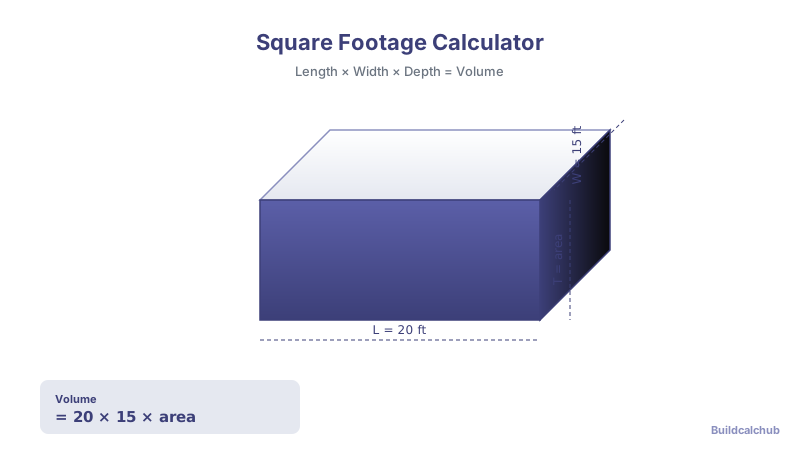
Simple Rectangular Patio 16 × 20 ft
Basic back patio measurement for flooring or surface estimate.
- Length
- 20 ft
- Width
- 16 ft
Takeaway: Direct L × W. Equivalent: 35.6 yd², 29.7 m².
L-Shaped Living Room
Combined living and dining area with 10 × 4 ft alcove off main room.
- Main area
- 14 × 20 ft = 280 ft²
- Alcove
- 10 × 4 ft = 40 ft²
Takeaway: Decompose irregular shapes into simple rectangles, sum separately. Same total as rectangular, but precision matters on flooring/paint orders.
Circular Fire Pit Pad 8 ft diameter
Round patio area for fire pit installation.
- Diameter
- 8 ft
- Radius
- 4 ft
Takeaway: π × 4² = 50.3 ft². For concrete, with 6 inches depth: 25.1 ft³ = 0.93 yd³.
Sources & Standards
These references are used for terminology, safety boundaries, and engineering assumptions. Local code, supplier specifications, and licensed design documents still control your project.
-
NIST Special Publication 811 — Guide for the Use of the International System of Units (SI)
National Institute of Standards and Technology
Cited for the official US conversion factors between US customary (inch, foot, yard) and SI (meter) units used in all volume and area calculations.
-
ASTM E1-14 — Standard Specification for ASTM Liquid-in-Glass Thermometers (and dimensional measurement standards)
ASTM International
Cited for measurement traceability and tolerance basis used in dimensional inputs.
-
USDA NRCS National Engineering Handbook — Earthwork
USDA Natural Resources Conservation Service
Cited for excavation volume math, shrink-swell factors, and cut-and-fill balance methodology.
-
USACE EM 1110-2-1906 — Laboratory Soils Testing
US Army Corps of Engineers
Cited for soil density, moisture content, and compaction methodology underlying volume-to-weight conversion.
-
IBC 2024 Table 1604.3 — Dead Loads
International Code Council
Cited for material dead-load values used in volume-to-weight conversions for slabs, decks, and structural members.
Frequently Asked Questions
How do I calculate square footage?
For rectangles: length × width (both in feet). For circles: π × radius². For triangles: (base × height) ÷ 2. For irregular shapes: decompose into rectangles and sum.
How many square feet in an acre?
One acre = 43,560 square feet. Equivalent to a square roughly 209 × 209 feet, or a rectangle 100 × 435.6 ft. Most suburban residential lots are 0.1-0.5 acre (4,356-21,780 ft²).
How many square feet in a square yard?
1 yd² = 9 ft² (since 1 yard = 3 feet, and a square yard is 3 × 3 ft). Flooring is often priced by yard² while room measurements are in ft² — divide ft² by 9 to get yd².
How do I measure an irregular room?
Draw a rough sketch. Divide into simple rectangles. Measure each rectangle. Sum the individual areas. For rooms with curves, use multiple small triangles to approximate the curved edge.
How many square feet is a typical house?
US average: 2,300-2,500 ft² for new construction. Starter homes: 1,200-1,800 ft². Luxury: 4,000+ ft². The ‘square footage’ figure typically excludes basement, garage, and porches (though basements are often included as ‘finished area’ if completed).
How is square footage measured for real estate?
Measured from the exterior walls for single-family homes, including hallways and stairs but excluding open spaces (2-story foyers count once). Excludes garages, covered porches, and unfinished basements. Varies slightly by region and by whether ANSI or local standard is used.
What's the minimum accuracy needed for construction?
For materials estimating: ±2-3% is the standard. For property boundary surveys: ±0.01 ft = 1/8 in. For casual estimates: ±5% is acceptable. Measure twice, especially corners where errors compound.