Sand Calculator for Tons, Cubic Yards, Bags and Cost
Estimate sand tonnage and cost for paver bedding, sandbox fills, masonry mortar, and drainage sand layers — with type recommendations for each use.
Sand Calculator
Enter project dimensions below — results update instantly. Switch units freely.
Estimates assume typical industry density and waste factors. Always verify with your supplier and local building code before purchasing material.
Why Sand Calculator Estimates Go Wrong
Order ‘sand’ at a supplier and they'll ask ‘what type?’ Saying ‘just regular sand’ will get you whatever they have a lot of — which may be the wrong product for your use.
- Concrete / mortar sand — washed, sharp-edged, clean. For mixing concrete, mortar, grout. Sold by the ton.
- Mason / brick sand — finely screened, uniform. For bricklaying mortar and tuckpointing. Slightly more expensive than concrete sand.
- Paver sand / bedding sand — coarse, angular, clean. For setting pavers and flagstone. ~1-inch thick layer under pavers.
- Polymeric sand — finer with polymer binders. For filling paver joints after installation; hardens when watered.
- Fill sand (bank run) — unwashed, variable. Cheapest option for pool backfill and rough grading only.
- Play sand — washed and sifted for sandboxes. Often bagged at big-box stores.
Using concrete sand for paver bedding works fine. Using mason sand for concrete weakens the mix because it's too fine.
How to Calculate Sand Calculator
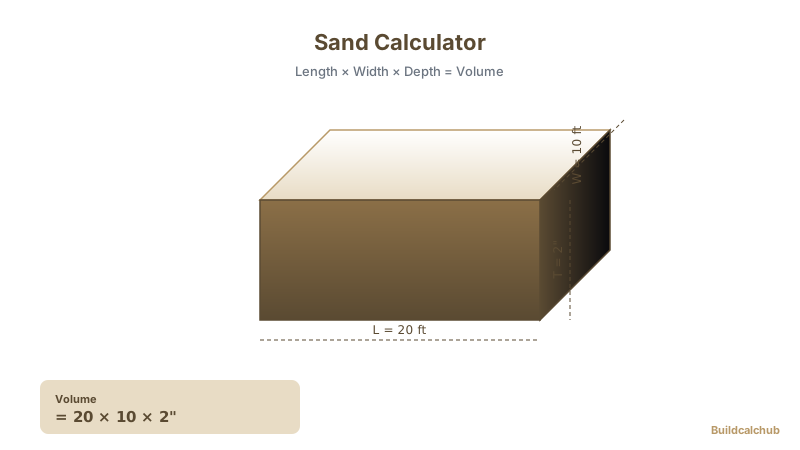
Dry sand density:
- Loose/dry: 95-100 lb/ft³
- Damp: 105-115 lb/ft³ (water adds weight)
- Saturated/wet: 120-130 lb/ft³
For ordering, use dry/loose density (100 lb/ft³). Sand coming from a wet pit gets heavier but the tonnage on the ticket is still based on loose fill.
Bag equivalents:
- 50-lb bag of play sand ≈ 0.5 ft³
- 60 bags of 50-lb ≈ 1 cubic yard
- Large 1-ton ‘sandbag tote’ ≈ 18-20 ft³
For projects over 3 cubic yards, always buy bulk by the ton at a landscape supplier — bagged sand runs $150-300 per equivalent ton vs. $25-45 at a yard.
Once the Sand Calculator result looks reasonable, cross-check the next job decision with the Paver Calculator and the Aggregate Calculator. That keeps the quantity, cost, and field assumption tied together before you call a supplier.
For the broader project context: the cubic yards vs tons conversion guide covers material-specific density (the 1.4 t/yd³ vs 2.0 t/yd³ question), the crushed stone sizes guide walks the #57 / #67 / #8 gradations, and the gravel depth chart sets coverage by application. For a full cluster overview see the aggregate & base pillar.
What Most Online Calculators Get Wrong Reviewed by Ethan Walker, Senior Asphalt Estimator & Paving Consultant (22 yrs)
AI tools quote sand as “1.5 tons per yard.” Four pitfalls AI summaries hide:
- Sand density varies 1.35 (dry) to 1.55 (saturated). Moisture matters.
- Concrete sand vs masonry sand vs play sand = different products.
- Coverage at 1 in: 1 ton covers ~200 sqft (bedding sand).
- Settles 5–10% over time.
This calculator outputs sand tonnage by type + moisture state + use-case coverage. Sand selection is 3 variables, not 1.
Sand Coverage Table and Material Reference
| Sand Type | Gradation | Best Use | Typical Price/ton |
|---|---|---|---|
| Paver / Bedding sand | Coarse, 1/8 in | Paver and flagstone setting | $32-48 |
| Concrete sand | Washed, 1/4 in top | Concrete and mortar mix | $28-42 |
| Mason sand | Fine, 1/16 in | Brick and block mortar | $38-55 |
| Polymeric sand | Very fine + binder | Paver joint filler | $1-2 per lb bag |
| Fill sand (bank run) | Unwashed, varies | Pool backfill, pipe bedding | $20-30 |
| Play sand (washed) | Fine, round | Sandboxes, volleyball courts | $5-8 per 50-lb bag |
| Torpedo sand | Coarse, washed | Horse arenas, drainage | $30-45 |
| Stone dust / screenings | Very fine crushed | Leveling base for pavers | $18-28 |
Prices at quarry gate (2026). Delivery adds $60-180 per truck. Bagged retail is 3-5× bulk pricing.
| Depth | ft² per Ton | ft² per yd³ | Tons per 100 ft² |
|---|---|---|---|
| 1/2 in | 480 ft² | 648 ft² | 0.21 tons |
| 1 in | 240 ft² | 324 ft² | 0.42 tons |
| 2 in | 120 ft² | 162 ft² | 0.83 tons |
| 3 in | 80 ft² | 108 ft² | 1.25 tons |
| 4 in | 60 ft² | 81 ft² | 1.67 tons |
| 6 in | 40 ft² | 54 ft² | 2.5 tons |
Based on 100 lb/ft³ dry density. Paver bedding typically 1 inch; sandbox typically 4-6 in; masonry mortar estimates use cubic feet per bag.
Real-World Example Calculations
Paver Patio Bedding 14 × 18 ft @ 1 in
Sand bedding layer under concrete pavers for a backyard patio.
- Length × Width
- 18 × 14 ft
- Depth
- 1 in
- Sand type
- Paver sand
Takeaway: Single pickup-truck load or 4-5 wheelbarrows. Screed to 1-inch thickness over compacted base.
Sandbox Fill 8 × 8 × 8 in deep
New sandbox for backyard play set.
- Length × Width
- 8 × 8 ft
- Depth
- 8 in
- Sand type
- Play sand
Takeaway: Bulk order saves $400+ vs bagged. Get a ½-cubic-yard delivery for a playset this size.
Pool Backfill 18 × 36 × 4 ft
In-ground pool backfill after pool removal.
- Length × Width
- 36 × 18 ft
- Depth
- 48 in (4 ft)
- Sand type
- Fill sand
Takeaway: Multi-truck delivery. Sand compacts more predictably than fill dirt for pool removal. Add 2 ft topsoil over sand for lawn restoration.
Sources & Standards
These references are used for terminology, safety boundaries, and engineering assumptions. Local code, supplier specifications, and licensed design documents still control your project.
-
AASHTO T 19/T 19M-22 — Standard Method of Test for Bulk Density (‘Unit Weight’) and Voids in Aggregate
AASHTO
Cited for the bulk density (loose-rodded unit weight) basis of all aggregate tons-per-cubic-yard figures.
-
ASTM C33/C33M-23 — Standard Specification for Concrete Aggregates
ASTM International
Cited for fine and coarse aggregate gradation requirements (#57, #67, #8 stone) referenced in the size and use-case tables.
-
ASTM D448-12(2017) — Standard Classification for Sizes of Aggregate for Road and Bridge Construction
ASTM International
Cited for the standardized aggregate gradation numbers (#1 through #67) used by aggregate suppliers.
-
AASHTO T 99-22 / T 180-22 — Standard Method of Test for Moisture-Density Relations of Soils Using a Standard Effort (Proctor)
AASHTO
Cited for the 95% Modified Proctor compaction standard used to derive the loose-to-compacted conversion factor.
-
FHWA Geotechnical Engineering Program
Federal Highway Administration
Cited for subgrade preparation and compaction practice underlying the base-course quantity calculations.
Frequently Asked Questions
How much sand do I need?
For 1-inch paver bedding: 0.42 tons per 100 ft². For 4-inch sandbox: 1.67 tons per 100 ft². Use this calculator for your exact dimensions.
What type of sand for a paver patio?
Paver sand / bedding sand — coarse, 1/8-in washed sand. ASTM C33 concrete sand also works. Do NOT use mason sand (too fine) or play sand (too round). Install as a 1-inch layer over compacted base.
How much sand is in a bag?
A 50-lb bag of play sand holds approximately 0.5 cubic feet. 60 × 50-lb bags = 1 cubic yard. Large 1-ton totes hold 18-20 ft³.
How much does sand cost?
Bulk at quarry: $20-45 per ton depending on type. Delivered: $40-75 per ton. Bagged play sand: $5-8 per 50-lb bag ($200-320 per equivalent ton). Always bulk-buy anything over 1 ton.
How deep should sand be under pavers?
1 inch, screeded level over compacted aggregate base. Thicker than 1 inch, pavers settle unevenly; thinner than 1 inch, pavers rest on base irregularities and rock. Never use sand instead of the aggregate base — sand alone can't support vehicle loads.
Can I use play sand for concrete?
No — play sand is washed to remove the fines that concrete needs for proper particle packing. Use concrete sand (ASTM C33) or specified mortar sand. Using play sand produces weak, crumbly concrete that fails under load.
How much sand for a horse arena?
Standard 70 × 140 ft arena (9,800 ft²) at 4-in depth: ~163 tons of torpedo sand or riding-arena-specific sand. Most arenas add a fiber or engineered footing product on top for extra cushion and stability.