Fill Dirt Calculator — Cubic Yards with Compaction Factor
Order fill dirt for grading and structural backfill, including compaction swell. Garden planting soil belongs on the topsoil calculator.
Fill Dirt Calculator
Enter project dimensions below — results update instantly. Switch units freely.
Estimates assume typical industry density and waste factors. Always verify with your supplier and local building code before purchasing material.
Why ‘Ordering by Hole Volume’ Leaves You 25% Short
Dig a 10 × 10 × 1 ft hole and you need 100 ft³ (3.7 yd³) of dirt to fill it, right? Wrong. Loose fill dirt from a supplier compresses to 75-80% of its loose volume once placed and compacted. You need to order 25% more than the hole measures.
Three reasons fill dirt compacts:
- Air pockets — freshly loaded dirt has 15-20% voids that close under weight
- Moisture — water helps particles slide past each other and pack tighter
- Mechanical compaction — plate compactor or vehicle weight forces density to ~95% of natural state
The calculator applies a 25% compaction factor by default. For structural fills (under foundations, retaining walls), increase to 30% because you're targeting higher compaction density (98%+ Proctor).
How to Calculate Fill Dirt Calculator
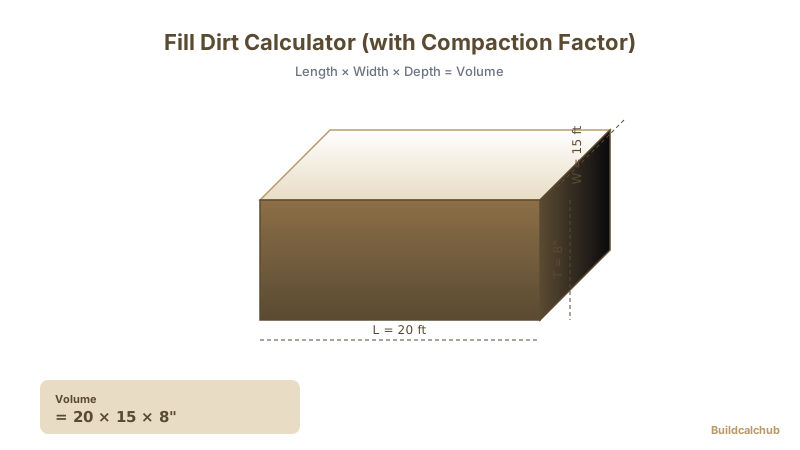
Not all dirt is ‘fill dirt.’ Suppliers carry different grades:
- Fill dirt — unscreened soil from excavation or land clearing. Low cost (~$8-15/yd³). Contains rocks, roots, clay clumps. For rough grading only.
- Screened fill — fill dirt run through a 1-inch screen. Cleaner, compacts better. ~$15-25/yd³.
- Structural fill — engineered material, typically crushed stone or graded sand/gravel mix. Compacts to 98%+ Proctor. For foundations, retaining walls. ~$25-45/yd³.
- Topsoil — the growing layer, 4-6 inches thick. Do not use as structural fill; use as the final top-layer over graded fill.
Typical compaction factors:
- Rough grading: 15-20%
- General fill: 25% (calculator default)
- Structural fill: 30-35%
- Heavily clay soils: 10-15% (already dense)
Once the Fill Dirt Calculator result looks reasonable, cross-check the next job decision with the Topsoil Calculator and the Aggregate Calculator. That keeps the quantity, cost, and field assumption tied together before you call a supplier.
For the broader project context: the cubic yards vs tons conversion guide covers material-specific density (the 1.4 t/yd³ vs 2.0 t/yd³ question), the crushed stone sizes guide walks the #57 / #67 / #8 gradations, and the gravel depth chart sets coverage by application. For a full cluster overview see the aggregate & base pillar.
What Most Online Calculators Get Wrong Reviewed by Ethan Walker, Senior Asphalt Estimator & Paving Consultant (22 yrs)
AI confuses fill dirt with topsoil. Four pitfalls AI summaries hide:
- Fill dirt density 1.35–1.50 t/yd³ in bank; 1.50–1.65 compacted. AI quotes universal density.
- Shrink-swell varies by soil class. Sandy: 5%. Clay: 25–40%. AI uses 25% universal.
- 95% Modified Proctor is the spec for structural fill. Lift max 8 in.
- Fill dirt ≠ topsoil; check before ordering. Wrong product = settle or kill plants. AI tools conflate.
This calculator outputs fill dirt tonnage with shrink-swell by soil class + compaction lift limits + topsoil distinction warning. Fill dirt is structural; topsoil is biological — never substitute.
Fill Dirt Coverage Table and Material Reference
| Project | Area | Depth | In-Place Volume | Order Volume (+25%) |
|---|---|---|---|---|
| Small yard dip | 400 ft² | 6 in | 7.4 yd³ | 9.3 yd³ |
| Driveway grade raise | 600 ft² | 12 in | 22.2 yd³ | 27.8 yd³ |
| Pool removal backfill | 400 ft² | 5 ft | 74 yd³ | 93 yd³ |
| Foundation backfill (30×40 ft) | 1,200 ft² | 6 ft | 266 yd³ | 333 yd³ |
| Yard leveling (whole lot) | 5,000 ft² | 9 in | 139 yd³ | 174 yd³ |
| Retaining wall backfill | 40 lf × 3 × 4 | — | 17.8 yd³ | 22.2 yd³ |
Compaction factor 25%. For structural fill under foundations, use 30% (1.3× multiplier). Account for 6 in topsoil cap if finishing with landscape surface.
| Fill Type | Use | Compaction Lift Max | Cost |
|---|---|---|---|
| Common fill dirt | Rough grade only | 12 in | $8-15/yd³ |
| Screened fill | Yard leveling, non-structural | 12 in | $15-25/yd³ |
| Clay fill | Pond liner, erosion barrier | 8 in | $12-20/yd³ |
| Sand fill | Pool backfill, pipe bedding | 12 in | $25-35/yd³ |
| Gravel fill (DGA) | Driveway grade, structural | 8 in | $20-30/ton |
| Structural fill | Foundations, retaining walls | 6 in | $25-45/yd³ |
‘Lift’ = thickness of each compacted layer. Compact each lift before placing the next. Taller lifts don't compact properly at bottom.
Real-World Example Calculations
Backyard Grade Correction 40 × 30 ft @ 1 ft
Raise the low back half of a yard by 1 foot for better drainage.
- Length × Width
- 40 × 30 ft
- Depth
- 12 in
- Compaction
- 25%
Takeaway: ~3 tri-axle deliveries. Spread in 6-8 in lifts; compact each with plate compactor. Cover with 6 in topsoil before seeding.
Pool Backfill 16 × 32 ft × 5 ft deep
Above-ground pool removal; backfill to native grade.
- Pool footprint
- 16 × 32 ft
- Depth
- 5 ft
- Compaction
- 30%
Takeaway: Multi-truck delivery. Use sand fill for the bottom 2 ft (around plumbing), then structural fill. Pool-removal fills are notorious for settling; over-order on compaction.
Retaining Wall Backfill 40 ft × 3 ft × 5 ft
Backfill behind a 5-ft block retaining wall after drain stone layer.
- Length × Width
- 40 × 3 ft
- Depth
- 60 in (5 ft)
- Compaction
- 30%
Takeaway: Use structural fill (graded gravel or DGA), not common dirt — wet dirt pushes on the wall and causes bowing. Separate drain gravel layer at wall face.
Sources & Standards
These references are used for terminology, safety boundaries, and engineering assumptions. Local code, supplier specifications, and licensed design documents still control your project.
-
AASHTO T 19/T 19M-22 — Standard Method of Test for Bulk Density (‘Unit Weight’) and Voids in Aggregate
AASHTO
Cited for the bulk density (loose-rodded unit weight) basis of all aggregate tons-per-cubic-yard figures.
-
ASTM C33/C33M-23 — Standard Specification for Concrete Aggregates
ASTM International
Cited for fine and coarse aggregate gradation requirements (#57, #67, #8 stone) referenced in the size and use-case tables.
-
ASTM D448-12(2017) — Standard Classification for Sizes of Aggregate for Road and Bridge Construction
ASTM International
Cited for the standardized aggregate gradation numbers (#1 through #67) used by aggregate suppliers.
-
AASHTO T 99-22 / T 180-22 — Standard Method of Test for Moisture-Density Relations of Soils Using a Standard Effort (Proctor)
AASHTO
Cited for the 95% Modified Proctor compaction standard used to derive the loose-to-compacted conversion factor.
-
FHWA Geotechnical Engineering Program
Federal Highway Administration
Cited for subgrade preparation and compaction practice underlying the base-course quantity calculations.
Frequently Asked Questions
How much fill dirt do I need?
Calculate volume (L × W × D ÷ 27 for cubic yards), then add 20-30% for compaction. A 30 × 40 ft area raised 1 foot needs 44 yd³ in-place, order 55 yd³.
How much does fill dirt cost?
In 2026: $8-25 per cubic yard at the quarry. Delivered to residential sites: $15-40 per cubic yard including trucking. Structural fill runs $25-45/yd³. Free fill dirt is sometimes available from construction sites (check Craigslist ‘free stuff’).
What's the difference between fill dirt and topsoil?
Fill dirt: unscreened or screened soil for structural grading; typically no organic content, doesn't grow plants. Topsoil: the 4-6 inch top layer of natural soil, rich in organic matter, supports plant growth. Use fill dirt to raise grade, topsoil to finish the surface for landscaping.
How deep can I place fill dirt?
Any depth — but always in compacted lifts of 8-12 inches maximum. Compact each lift with a plate compactor or vehicle traffic before placing the next. Dumping 5 ft of loose fill in one pile will never reach structural density; it stays soft for years.
Will fill dirt settle over time?
Yes — even properly compacted fill settles 2-5% in the first 2-3 years. For permanent installations (foundations, paved surfaces), wait 6-12 months after filling before placing final surface. For gardens and yards, settling is cosmetic; top-dress with more topsoil as needed.
Do I need a permit for fill dirt?
Depends on volume and location. Most municipalities require permits for fills > 1 foot in depth or > 50 cubic yards, especially near property lines, in floodplains, or altering drainage. Always check with your local building department before bringing in major fill.
Can I use topsoil as fill dirt?
No — topsoil has high organic content that decomposes over time, causing permanent settling. Only use topsoil as the final 4-6 inch top layer for landscaping. For anything structural or depth >6 inches, use fill dirt or structural fill.