Concrete PSI Guide (3,000 / 4,000 / 5,000 psi)
Which concrete strength is right for your project? This guide explains PSI ratings, what they mean in practice, and which one to spec for driveways, foundations, slabs, and specialty applications.
What PSI Actually Measures
PSI stands for pounds per square inch of compressive strength at 28 days after pour. It's measured by crushing test cylinders in a laboratory press. 3,000 psi concrete requires 3,000 pounds of force per square inch to fail in compression.
Why 28 days? Concrete gains strength over time as cement hydrates:
- Day 1: ~16% of final strength
- Day 3: ~40%
- Day 7: ~65%
- Day 14: ~85%
- Day 28: 100% (design strength)
- Day 90: ~108%
- Year 1: ~115% (still gaining slowly)
PSI specifies the minimum required strength at 28 days. Higher PSI means stronger, more durable concrete — and higher material cost.
The 5 Common Strength Grades
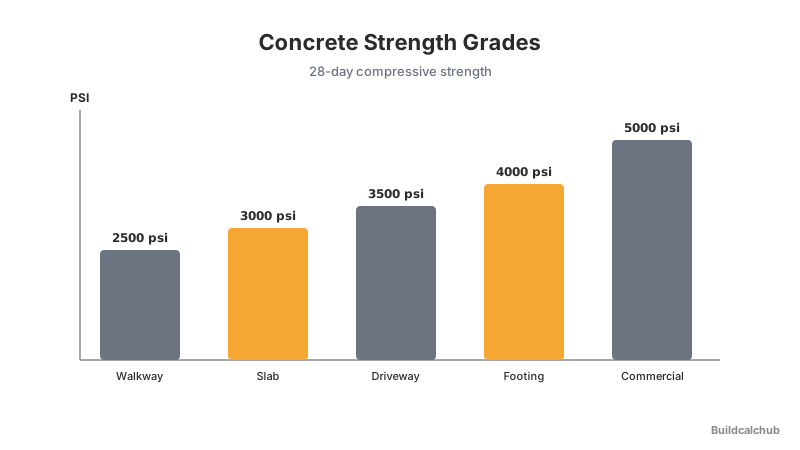
- 2,500 psi — Non-structural, general-purpose. Sometimes used for sidewalks and light-duty work. Rare in modern residential.
- 3,000 psi — Standard residential. Patios, walkways, non-load-bearing slabs. Most cost-effective grade.
- 3,500 psi — Upgraded residential. Better-grade patios, driveways, above-grade walls. ~$10 more per cubic yard than 3,000 psi.
- 4,000 psi — Structural residential. Foundations, footings, garage floors, retaining walls. IRC minimum for most structural elements.
- 4,500-5,000 psi — Heavy-duty residential / light commercial. Industrial floors, heavy loading, specialty applications.
- 5,500+ psi — Commercial / engineered. Bridge decks, parking structures, post-tensioned slabs.
Applications by PSI
Here's the practical mapping:
Cost vs. Strength Tradeoff
Moving from 3,000 psi to 4,000 psi costs roughly $15-20 per cubic yard more. For a typical 5-yd³ residential slab, that's $75-100 extra — a small price for 33% more structural strength.
Moving from 4,000 psi to 5,000 psi costs another $15-30/yd³ — returns diminish. Only spec 5,000+ psi when:
- Structural engineer has sized for it
- Heavy industrial or commercial loading
- Freeze-thaw durability critical
- Post-tensioned or pre-stressed applications
- Fast turn-around projects needing high early strength
For most residential work, 4,000 psi is the sweet spot: IRC-compliant, strong enough for any homeowner application, reasonably priced.
What PSI actually buys you beyond the code minimum
IRC requires a 2,500 psi minimum for residential footings and slabs on grade. Most ready-mix plants don't sell 2,500 psi because it's barely a commercially-viable product; the default is 3,000 psi. That default is what shows up in almost every residential bid, and it is usually the right call.
Above 3,000 psi, the question becomes whether the additional strength justifies the additional cost. Moving from 3,000 to 4,000 psi raises material cost roughly $8 to $14 per cubic yard and increases durability, abrasion resistance, and freeze-thaw resistance measurably. On a driveway or a garage slab exposed to salt, I specify 4,000 psi as a baseline because chloride penetration drops almost in half between 3,000 and 4,000 psi mixes. The $60 to $80 delta on a two-car garage slab pays back the first time the homeowner parks a salty car on it.
Moving from 4,000 to 5,000+ psi is reserved for structural members carrying heavy loads (columns, deep footings, bearing walls over one story). For a residential garage floor, 5,000 psi is overspecified and the material is harder to finish smoothly because it sets faster.
Air entrainment interacts with strength: a standard air-entrained mix (4 to 6% air) loses about 4 to 5% strength per 1% air, so a 4,000 psi design with 6% air tests more like 3,600 to 3,700 psi. Freeze-thaw zones require air entrainment regardless; I bump the design to 4,500 psi to land at 4,000 psi actual. This is the kind of adjustment ready-mix plants handle automatically if you tell them the exposure class, but I always confirm.
What Most Online Calculators Get Wrong Reviewed by Michael Carter, Concrete & Foundation Estimation Specialist (15 yrs)
“What PSI concrete do I need” gets one universal AI answer: 3,000 psi for residential. That's the absolute minimum residential code (ACI 332) allows. Four pitfalls the 3,000-psi shorthand collapses:
- 3,000 psi is the residential minimum, not the spec. ACI 332 residential code allows 3,000 psi for interior slabs. Anything exposed to freeze-thaw, exterior, vehicle traffic, or structural load needs 4,000+ psi. AI tools default to 3,000; field practice defaults to 4,000 for exterior + 4,500 for driveways.
- Higher PSI ≠ more cement. 4,500 vs 3,000 psi is a 50% strength gain at ~5% material cost ($3–$8 per cubic yard). The mix design (water/cement ratio, fly ash, aggregate gradation) drives strength more than cement quantity. AI tools quote “X bags of cement”; field engineers spec PSI and let the ready-mix plant design the mix.
- Air entrainment is the freeze-thaw armor AI omits. 4,500 psi air-entrained (5–7% air) survives freeze-thaw cycles for decades. 4,500 psi non-air-entrained spalls in 5–8 years in any zone north of I-40. Air entrainment costs $2–$4 per yd³ and is non-negotiable for exterior work in freeze climates. AI tools never mention it.
- Rebar bond requires 3,500+ psi for proper development length. ACI 318 development-length formulas assume fc' ≥ 3,500 psi. Below that, your rebar slips before the concrete reaches design moment. AI tools recommend rebar without flagging the PSI floor; reinforced work always needs 4,000+ psi.
This guide gives PSI selection by application (8 use cases), the air-entrainment requirement matrix (climate × application), the rebar-bond PSI floor, and the mix-design parameter explanations (water/cement, fly ash %, aggregate gradation). Spec'ing 4,000 vs 3,000 psi adds $0.18/sqft to a slab and doubles the service life. It's the highest-leverage decision in concrete work.
Reference Tables
| Application | Minimum PSI | Recommended PSI | Code Reference |
|---|---|---|---|
| Walkway / sidewalk | 2,500 psi | 3,000 psi | — |
| Patio (non-structural) | 3,000 psi | 3,500 psi | — |
| Residential driveway | 3,500 psi | 4,000 psi | — |
| Garage floor | 4,000 psi | 4,000 psi | IRC 506.2.1 |
| RV / boat pad | 4,500 psi | 4,500 psi | — |
| Basement slab | 3,500 psi | 4,000 psi | IRC 506.2.1 |
| Continuous footing | 3,000 psi | 3,500 psi | IRC 403.1 |
| Foundation walls | 3,000 psi | 4,000 psi | IRC 404 |
| Pre-stressed / post-tensioned | 5,000 psi | 6,000+ psi | ACI 318 |
| Commercial slab | 4,000 psi | 4,500-5,000 psi | ACI 301 |
| Freeze-thaw exposure | 4,500 psi + air | 5,000 psi + air | ACI 301 |
| Agricultural / feedlot | 4,000 psi + acid-resistant | per design | ACI 350 |
Add air entrainment (5-7%) for any concrete exposed to freeze-thaw cycles. Increases freeze-thaw durability 5×.
| PSI Grade | Price/yd³ Delivered | Premium vs 3,000 psi | Typical Truck Minimum |
|---|---|---|---|
| 3,000 psi | $145-165 | baseline | 1 yd³ + $85 fee |
| 3,500 psi | $150-170 | +$5-10 | 1 yd³ + $85 fee |
| 4,000 psi | $160-180 | +$15-20 | 1 yd³ + $85 fee |
| 4,500 psi | $170-195 | +$25-35 | 1 yd³ + $85 fee |
| 5,000 psi | $180-210 | +$35-45 | 1 yd³ + $85 fee |
| 6,000 psi | $195-230 | +$50-65 | 1 yd³ + $85 fee |
Pricing for standard Type I cement mixes. Specialty mixes (high-early, polymer, air-entrained) add $10-40/yd³ on top.
| Element | Minimum PSI (code) | Recommended PSI (2026 practice) | Exposure class | Air content | ACI 318 / IRC reference |
|---|---|---|---|---|---|
| Plain footing (lightly loaded) | 2,500 psi | 3,000 psi | F0 / S0 | n/a | ACI 318-19 Table 19.2.1.1 |
| Reinforced footing (residential) | 3,000 psi | 3,500–4,000 psi | F0–F1 | 5–7% if exposed | IRC R403.1.3.2 / ACI 318-19 19.2.1 |
| Foundation wall (basement) | 3,000 psi | 4,000 psi | F1 / S1 | 5–7% | IRC R404 / ACI 332 |
| Slab on grade (interior) | 3,000 psi | 3,500–4,000 psi | F0 | n/a | ACI 360R / IRC R506.2.1 |
| Slab on grade (garage) | 3,500 psi | 4,000 psi | F1 | 5–7% | IRC R506.2.1 |
| Driveway slab (residential) | 3,500 psi | 4,000 psi + air | F2 | 5–7% | ACI 332R / ACI 332.1R |
| Driveway slab (heavy vehicle) | 4,000 psi | 4,500–5,000 psi + air | F2–F3 | 6–7% | ACI 332R + custom design |
| Sidewalk / patio | 3,000 psi | 3,500 psi + air (freeze zone) | F1 | 5–7% | ACI 332R |
| Retaining wall | 3,000 psi | 4,000 psi | F1 | 5–7% | ACI 318 + ICC IRC R404.4 |
| Pier / column (residential) | 3,000 psi | 4,000 psi | F1 | 5–7% | ACI 318-19 18.4 |
| Suspended slab (post-tension) | 4,000 psi | 5,000 psi + low-shrink | F1 | as designed | ACI 318-19 24.5 + ACI 318 18.6 |
| Pool deck (chlorinated exposure) | 4,000 psi | 4,500 psi + air | S1 / C1 | 5–7% | ACI 350 |
| Chemical / agricultural floor | 4,000 psi + acid-resistant | 5,000+ psi acid-resistant | C2–C3 | 5–7% | ACI 350 |
| Bridge deck / parking structure | 4,500 psi | 5,000–6,000 psi | F3 / C2 | 5–7% | ACI 318 + AASHTO LRFD |
Exposure class definitions per ACI 318-19 Section 19.3: F = freezing/thawing (F0 not exposed; F1 occasional; F2 frequent + moisture; F3 frequent + de-icers); S = sulfate exposure; C = corrosion of reinforcement. Most residential drives in the freeze belt (Mid-Atlantic / Northeast / Midwest) require F2 + 5–7% air entrainment; in freeze + de-icer zones bump to F3. For the curing-temperature impact on the strength curve see our concrete curing time chart.
Specialty Mixes
Beyond basic PSI ratings, several specialty properties may be specified:
- Air-entrained (5-7% air) — Improves freeze-thaw durability by 5×. Required for exterior concrete in freeze zones. Adds $10-15/yd³.
- High-early-strength — Reaches 3,000 psi in 3 days instead of 7. Use for fast-track projects. Adds $20-40/yd³.
- Fiber-reinforced (synthetic) — Chopped polypropylene fibers control shrinkage cracking. Adds $8-12/yd³.
- Polymer-modified (latex) — Improves tensile strength and chemical resistance. Adds $30-60/yd³.
- Self-consolidating (SCC) — Flows into place without vibration. For complex forms with heavy rebar. Adds $25-40/yd³.
- Low-shrinkage — Reduced water content; minimizes crack formation. Adds $15-25/yd³.
- Colored / stamped — Decorative concrete. Adds $30-80/yd³ for color, plus stamp rental.
Field tricks for matching PSI to the actual job
- Don't size the PSI to the highest-risk moment. A residential driveway that sees one heavy moving truck per decade does not need 5,000 psi. Size the PSI to the routine load, not the rare one. Temporary matting under the moving truck is $180 insurance that avoids $3,000 of upgraded concrete.
- Match the finish to the PSI. A 4,000 psi mix hardens faster than a 3,000 psi mix. If your crew is accustomed to a 3,000 psi slump schedule, moving them to 4,000 psi without adjustment can cause finishing-too-late cracks. Coordinate with the crew ahead of time.
- Specify the exposure class with the PSI. "4,000 psi, C1 (exposed to freezing, not saturated), 6% air" is a complete spec. "4,000 psi" alone is not. I've inherited projects where the specification read just the PSI number and the plant made reasonable assumptions that turned out not to match the project.
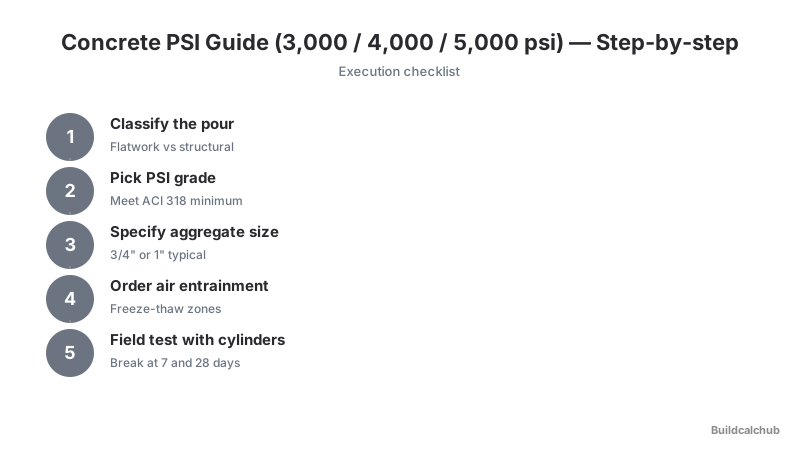
- Test cylinders at 7 days AND 28 days. A 7-day break typically reaches 65 to 70% of 28-day strength. If your 7-day result is below 55% of design PSI, the 28-day result will fail and you want to know now, not later.
- Get the mix design before the pour. A 4,000 psi mix from one plant is not identical to a 4,000 psi mix from another plant. Request the submittal mix design in writing and verify it meets your design requirements.
On a post-tension slab job I consulted on outside Philadelphia in 2021, the specified 5,000 psi mix was delivered at 4,200 psi measured strength. The issue wasn't batching; it was that the plant had changed aggregate sources and hadn't re-run the mix design. My field test caught the discrepancy on day 7. We pulled the remaining pours, the plant adjusted cement content, and the slab was saved. Early testing is cheap insurance.
Real-World Example Calculations
Common Residential PSI Spec
New home construction: foundation + garage slab + driveway.
- Footings
- 3,500 psi (IRC 403 min)
- Foundation walls
- 4,000 psi
- Garage slab
- 4,000 psi (IRC 506)
- Basement slab
- 3,500 psi
- Driveway
- 4,000 psi + air-entrainment
- Front walkway
- 3,000 psi + air-entrainment
Takeaway: Specifying by application keeps cost optimal — don't over-spec non-structural walkways to 5,000 psi.
Next Steps and Related Calculators
Once you've picked PSI, use the Concrete Calculator for cubic yards and bag counts. For larger projects, confirm truck capacity with the Concrete Calculator. Structural applications also need rebar sized correctly. For the day-by-day strength gain curve that drives strip-form decisions see concrete curing time chart; for the mix ratio + water-cement ratio that produces the PSI see concrete mix ratio guide.
Sources & Standards
These references are used for terminology, safety boundaries, and engineering assumptions. Local code, supplier specifications, and licensed design documents still control your project.
-
ACI Concrete Terminology and Technical Resources
American Concrete Institute
Used for concrete strength terminology, mix design concepts, and structural concrete references.
-
ASTM C33/C33M: Standard Specification for Concrete Aggregates
ASTM International
Referenced for concrete aggregate grading and quality terminology.
-
ICC Digital Codes: International Residential Code
International Code Council
Referenced for residential footing, slab, deck, and code-compliance terminology.
-
OSHA Trenching and Excavation Safety
Occupational Safety and Health Administration
Referenced for excavation safety, protective systems, and worker-safety boundaries.
Frequently Asked Questions
What PSI concrete should I use for a driveway?
3,500-4,000 psi for residential driveways. Air-entrained (5-7%) if in freeze zones. For heavier vehicle loads (RV pads, tow-truck parking): 4,500 psi.
What's the difference between 3,000 and 4,000 psi concrete?
Compressive strength: 3,000 psi holds 3,000 lb/in²; 4,000 psi holds 4,000 lb/in² — 33% more. Cost: 4,000 psi is $15-20 more per yd³. 4,000 psi is IRC-mandated for foundations, footings, and garage floors.
Is higher PSI concrete better?
Only within a range. For residential, 4,000 psi is the practical maximum benefit. Above that, cost rises faster than benefit for most homeowner projects. Commercial and engineered projects benefit from 5,000+ psi.
How long until concrete reaches full strength?
28 days for design (specified) strength. 70% at 7 days (foot traffic OK). Continues gaining slightly up to 90 days and beyond. Keep concrete moist (water-cured) for the first 7 days for maximum strength gain.
What PSI is 80-lb Quikrete?
Standard Quikrete 80-lb ‘concrete mix’ cures to 4,000 psi at 28 days. Specialty Quikrete products: 5000 Concrete Mix = 5,000 psi; Crack-Resistant = 4,000 psi + fiber; Fast-Setting = 4,000 psi in 1 hour. Check the specific product label.
Do I need to specify PSI when ordering ready-mix?
Yes — always. Ready-mix plants batch different mixes throughout the day. Specifying PSI is how you get the correct mix delivered. Failure to specify defaults to whatever the plant is running, which may not meet your needs.
What does 'air-entrained' mean?
Deliberate incorporation of tiny air bubbles (5-7% by volume) distributed through the concrete. These bubbles act as expansion chambers when water in concrete pores freezes, preventing freeze-thaw damage. Required for all exterior concrete in freeze zones. Adds $10-15/yd³.