Slope Calculator for Percent Grade, Degrees and Rise-Run Ratio
Convert between percent grade, degrees, and ratio slope for driveways, roofs, drainage, ramps, and accessibility calculations — all three formats in one calculator.
Slope Calculator
Enter project dimensions below — results update instantly. Switch units freely.
Estimates assume typical industry density and waste factors. Always verify with your supplier and local building code before purchasing material.
Why Slope Is Expressed Three Different Ways
Slope can be expressed as percent, degrees, or rise:run ratio — and different industries use different conventions:
- Percent — civil engineering, drainage, driveways, ADA ramps. Example: ‘2% cross-slope’.
- Degrees — general geometry, ski slopes, angular measurements. Example: ‘45-degree slope’.
- Rise:Run ratio — roofing, stairs, ramps, construction. Example: ‘4:12 roof pitch’ or ‘1:12 ramp’.
Conversion logic:
- Percent = (rise ÷ run) × 100
- Degrees = arctan(rise ÷ run)
- Rise:Run = rise / run (e.g., 1:12 = 1 unit rise per 12 units run)
Common equivalences:
- 1% = 0.57° = 1:100
- 2% = 1.15° = 1:50 (standard patio drainage)
- 5% = 2.86° = 1:20 (ADA max ramp)
- 8.33% = 4.76° = 1:12 (wheelchair accessible)
- 25% = 14° = 1:4 (maximum car driveway)
- 33% = 18.4° = 1:3 (max steep driveway with 4WD)
- 100% = 45° = 1:1
How to Calculate Slope Calculator
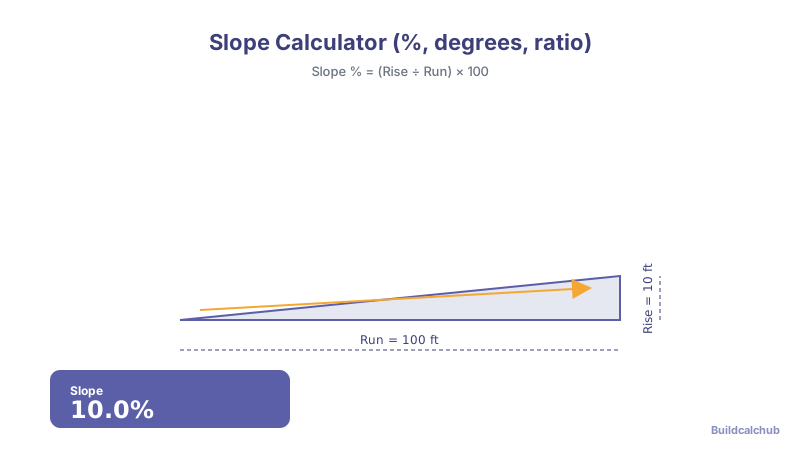
Degrees = arctan(Rise ÷ Run)
Rise:Run = Rise ÷ Run
Critical slopes by application:
- Drainage minimum: 1% (1/8" per foot) for paved surfaces, 2% for lawns
- ADA wheelchair ramp: max 8.33% (1:12). Max 30 ft length before landing.
- Patio drainage: 2% slope away from house (1/4 in per foot)
- Driveway: max 14% sustained, 8-10% preferred
- Driveway on hillside: max 20% for 20 ft length, with transition zones
- Stair rise:run: 7" rise × 11" run = 1.57 slope ratio = 32.5°
- Roof low-slope: 1:12 to 3:12 (requires special roofing systems)
- Roof standard: 4:12 to 9:12
- Roof steep: 9:12 and above
Once the Slope Calculator result looks reasonable, cross-check the next job decision with the Area Calculator and the Square Footage Calculator. That keeps the quantity, cost, and field assumption tied together before you call a supplier.
For related measurement math: the cubic yard calculator for volume; the square footage calculator for area; the cubic yards vs tons guide for converting volume to ordering tonnage. For the cluster overview see the measurement & volume pillar.
What Most Online Calculators Get Wrong Reviewed by Ethan Walker, Senior Asphalt Estimator & Paving Consultant (22 yrs)
AI tools calculate slope as rise/run. Four pitfalls AI summaries hide:
- 5% max for ADA-accessible routes.
- 2% max cross-slope.
- Ratio 10:1 = 10%; 12:1 = 8.33%.
- Direction matters more than magnitude. 2% toward house = water damage.
This calculator outputs slope % + ratio + ADA check + direction verification. Slope is direction + magnitude + compliance — AI's % alone misses 3 of 4.
Slope Unit Conversion and Measurement Reference Table
| Percent | Degrees | Rise:Run | Inches per Foot | Typical Use |
|---|---|---|---|---|
| 0.5% | 0.29° | 1:200 | 1/16" | Interior floor drain |
| 1% | 0.57° | 1:100 | 1/8" | Min drainage paved surface |
| 2% | 1.15° | 1:50 | 1/4" | Patio drainage, walkways |
| 3% | 1.72° | 1:33 | 3/8" | Heavy drainage |
| 5% | 2.86° | 1:20 | 5/8" | ADA ramp max |
| 8.33% | 4.76° | 1:12 | 1" | Accessible wheelchair ramp |
| 10% | 5.71° | 1:10 | 1.2" | Steep driveway limit (paved) |
| 14% | 7.97° | 1:7.1 | 1.68" | Max driveway sustained |
| 20% | 11.3° | 1:5 | 2.4" | Max driveway short segment |
| 25% | 14° | 1:4 | 3" | Severe driveway (4WD) |
| 33% | 18.4° | 1:3 | 4" | Drainage ditch side |
| 50% | 26.6° | 1:2 | 6" | Hillside grade |
| 100% | 45° | 1:1 | 12" | Steep roof |
Always verify with code: ADA, IRC, and local codes set enforceable slope limits for specific applications.
| Rise:Run | Percent | Degrees | Classification |
|---|---|---|---|
| 1:12 | 8.33% | 4.76° | Low-slope (single-ply required) |
| 2:12 | 16.67% | 9.46° | Low-slope |
| 3:12 | 25% | 14.04° | Low-moderate |
| 4:12 | 33.33% | 18.43° | Moderate / standard |
| 5:12 | 41.67% | 22.62° | Moderate |
| 6:12 | 50% | 26.57° | Medium-steep |
| 8:12 | 66.67% | 33.69° | Steep |
| 10:12 | 83.33% | 39.81° | Very steep |
| 12:12 | 100% | 45° | Extreme |
Lower roof pitches (≤ 2:12) require membrane roofing or hot-mop. Pitches 4:12 to 9:12 work with standard asphalt shingles. Above 12:12 requires specialty fastening.
Real-World Example Calculations
Driveway Slope Check
Homeowner measuring existing driveway slope for possible concrete replacement.
- Horizontal length
- 50 ft
- Vertical drop
- 4 ft
Takeaway: Within normal driveway range. If you can walk up without effort, car clearance is almost certainly fine.
ADA Wheelchair Ramp
Building code-compliant ramp to front door, 3-foot elevation.
- Vertical rise
- 36 in (3 ft)
- Required ratio
- 1:12
Takeaway: Any ramp over 30 ft needs a 60-inch landing. Break into two 15-foot runs with a landing in the middle.
Patio Drainage Slope
Backyard patio sized for proper water drainage away from house.
- Patio length
- 16 ft
- Required slope
- 2%
Takeaway: Patio near house at grade 0, far end 4 in lower. Allows water to flow away from foundation naturally.
Sources & Standards
These references are used for terminology, safety boundaries, and engineering assumptions. Local code, supplier specifications, and licensed design documents still control your project.
-
NIST Special Publication 811 — Guide for the Use of the International System of Units (SI)
National Institute of Standards and Technology
Cited for the official US conversion factors between US customary (inch, foot, yard) and SI (meter) units used in all volume and area calculations.
-
ASTM E1-14 — Standard Specification for ASTM Liquid-in-Glass Thermometers (and dimensional measurement standards)
ASTM International
Cited for measurement traceability and tolerance basis used in dimensional inputs.
-
USDA NRCS National Engineering Handbook — Earthwork
USDA Natural Resources Conservation Service
Cited for excavation volume math, shrink-swell factors, and cut-and-fill balance methodology.
-
USACE EM 1110-2-1906 — Laboratory Soils Testing
US Army Corps of Engineers
Cited for soil density, moisture content, and compaction methodology underlying volume-to-weight conversion.
-
IBC 2024 Table 1604.3 — Dead Loads
International Code Council
Cited for material dead-load values used in volume-to-weight conversions for slabs, decks, and structural members.
Frequently Asked Questions
How do I calculate slope percent?
(Rise ÷ Run) × 100. Example: 4-ft rise over 50-ft run = (4 ÷ 50) × 100 = 8%. Rise and run must be in the same units.
What is the maximum driveway slope?
14% sustained is the practical max for passenger vehicles; 20% for short segments (under 20 ft); 25%+ only for 4WD vehicles. Beyond that, approach and departure angles cause bumper scraping on transitions.
What's the ADA wheelchair ramp slope?
1:12 (8.33%, 4.76°) maximum. 1:16 preferred for long ramps. Maximum 30 ft between landings. Landings must be 60 × 60 in minimum.
How do I convert slope percent to degrees?
Degrees = arctan(percent / 100). Example: 10% = arctan(0.10) = 5.71°. Mental shortcut: for slopes under 10%, percent × 0.57 ≈ degrees.
What does 4:12 roof pitch mean?
The roof rises 4 inches of vertical for every 12 inches of horizontal run. Equivalent to 33.33% slope or 18.43°. 4:12 is a common residential pitch — works with standard asphalt shingles and sheds water well.
What's the minimum drainage slope?
1% (1/8 in per foot) for paved surfaces (driveways, patios, walkways). 2% preferred for lawns and mulched areas. 1/4 in per foot (2%) for patios away from houses — prevents water pooling against foundations.
How is slope measured in the field?
Three tools in order of accuracy: (1) Smart level / digital level ($40-80) reads to 0.1°; (2) Laser level with grade rod ($150-400) for long distances; (3) Survey total station ($5,000+) for professional accuracy. For DIY projects, a smart phone inclinometer app is adequate (±1°).