Road Base Calculator for Tons, Depth and Compacted Sub-Base
Estimate tonnage for compacted aggregate sub-base under asphalt, concrete, or gravel surfaces — road-building grade with the higher density typical for dense-graded aggregate.
Road Base Calculator
Enter project dimensions below — results update instantly. Switch units freely.
Estimates assume typical industry density and waste factors. Always verify with your supplier and local building code before purchasing material.
Why Road Base Calculator Estimates Go Wrong
‘Road base’ and ‘gravel’ get used interchangeably in casual conversation. On a job site they mean different products:
- Gravel — generic term for any loose stone aggregate, rounded or angular
- Road base — specific dense-graded aggregate engineered for compaction under pavement
Road base has three distinguishing features:
- Dense gradation — full size range from dust to 1 inch. Small particles fill voids between large ones for maximum density.
- Angular shape — crushed stone, not river rock. Angular faces interlock when compacted.
- Plasticity index controlled — moderate clay content allows compaction to 95%+ Proctor without being susceptible to frost heave.
Other names for the same material: DGA (Dense-Graded Aggregate), crusher run, Class 5 (Midwest), 3/4 minus, Base Type 1. All referring to compactable sub-base aggregate at ~110 lb/ft³.
How to Calculate Road Base Calculator
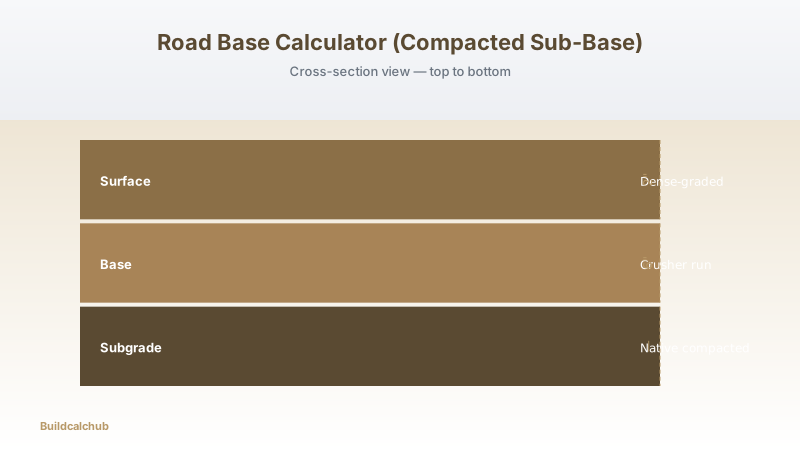
Road base density at 110 lb/ft³ is ~10% higher than uniformly graded #57 because of the full gradation filling voids.
Road base thickness by pavement type:
- Residential walkway: 4 in minimum
- Residential driveway (passenger cars): 4-6 in
- Driveway with occasional trucks / RV: 8 in
- Commercial parking lot: 8-10 in
- Heavy commercial / truck staging: 12 in
- Local road: 8-12 in
- State highway: 10-14 in
- Interstate: 12-18 in
Compaction in lifts of 6-8 inches max. Deeper lifts don't reach specified density at the bottom. A plate compactor handles up to 6 in; a vibratory roller handles up to 8-10 in per lift.
Once the Road Base Calculator result looks reasonable, cross-check the next job decision with the Gravel Calculator and the Crushed Stone Calculator. That keeps the quantity, cost, and field assumption tied together before you call a supplier.
For the broader project context: the cubic yards vs tons conversion guide covers material-specific density (the 1.4 t/yd³ vs 2.0 t/yd³ question), the crushed stone sizes guide walks the #57 / #67 / #8 gradations, and the gravel depth chart sets coverage by application. For a full cluster overview see the aggregate & base pillar.
What Most Online Calculators Get Wrong Reviewed by Ethan Walker, Senior Asphalt Estimator & Paving Consultant (22 yrs)
AI tools calculate road base as one density. Four pitfalls AI summaries hide:
- Road base = DGA = 1.55 loose / 1.85 compacted.
- 95% Modified Proctor required for road service.
- Lift max 6–8 in compacted.
- Gradation: 3/4-in top, fines at #200 max 8%.
This calculator outputs road base tonnage at correct DGA density + compaction lift limits + gradation reference. Road base is 4 specs: tonnage + density + compaction + gradation.
Road Base Coverage Table and Material Reference
| Area | 4 in depth | 6 in depth | 8 in depth | 12 in depth |
|---|---|---|---|---|
| 100 ft² | 1.8 tons | 2.75 tons | 3.67 tons | 5.5 tons |
| 500 ft² | 9.2 tons | 13.8 tons | 18.3 tons | 27.5 tons |
| 1,000 ft² | 18.3 tons | 27.5 tons | 36.7 tons | 55 tons |
| 2,500 ft² | 45.8 tons | 68.8 tons | 91.7 tons | 137.5 tons |
| 5,000 ft² | 91.7 tons | 137.5 tons | 183.3 tons | 275 tons |
| 10,000 ft² | 183 tons | 275 tons | 367 tons | 550 tons |
Based on 110 lb/ft³ compacted density. Order 10% extra for compaction loss; in-place volume is smaller than ordered volume.
| Sieve Size | % Passing (typical) |
|---|---|
| 1 in (25 mm) | 100% |
| 3/4 in (19 mm) | 85-100% |
| 3/8 in (9.5 mm) | 50-85% |
| #4 (4.75 mm) | 35-65% |
| #40 (0.425 mm) | 15-30% |
| #200 (0.075 mm) | 5-15% |
AASHTO M147 & state DOT specs vary slightly. Full gradation from 3/4 in down to fines enables maximum compaction density.
Real-World Example Calculations
Country Driveway 12 × 200 ft @ 6 in base
New gravel driveway sub-base from road to barn.
- Length × Width
- 200 × 12 ft
- Depth
- 6 in
- $/ton
- $22
Takeaway: 3 tri-axle deliveries. Place in 2 × 3-in lifts, compact each. Top with 2 in #57 stone for driving surface.
Parking Lot Sub-Base 100 × 80 ft @ 8 in
Commercial parking lot base under 3-in asphalt surface.
- Length × Width
- 100 × 80 ft
- Depth
- 8 in
- $/ton
- $24
Takeaway: ~13 tri-axle deliveries. Place in 4-in lifts; compact with vibratory roller to 95% Proctor before asphalt placement.
Highway Sub-Base 0.25 mi × 48 ft @ 12 in
State highway rebuild with full-depth sub-base replacement.
- Length × Width
- 1,320 × 48 ft
- Depth
- 12 in
- $/ton
- $20
Takeaway: Multi-week project. Place in 6-in lifts, compact each with sheepsfoot or vibratory roller. Density testing every 200 ft.
Sources & Standards
These references are used for terminology, safety boundaries, and engineering assumptions. Local code, supplier specifications, and licensed design documents still control your project.
-
AASHTO T 19/T 19M-22 — Standard Method of Test for Bulk Density (‘Unit Weight’) and Voids in Aggregate
AASHTO
Cited for the bulk density (loose-rodded unit weight) basis of all aggregate tons-per-cubic-yard figures.
-
ASTM C33/C33M-23 — Standard Specification for Concrete Aggregates
ASTM International
Cited for fine and coarse aggregate gradation requirements (#57, #67, #8 stone) referenced in the size and use-case tables.
-
ASTM D448-12(2017) — Standard Classification for Sizes of Aggregate for Road and Bridge Construction
ASTM International
Cited for the standardized aggregate gradation numbers (#1 through #67) used by aggregate suppliers.
-
AASHTO T 99-22 / T 180-22 — Standard Method of Test for Moisture-Density Relations of Soils Using a Standard Effort (Proctor)
AASHTO
Cited for the 95% Modified Proctor compaction standard used to derive the loose-to-compacted conversion factor.
-
FHWA Geotechnical Engineering Program
Federal Highway Administration
Cited for subgrade preparation and compaction practice underlying the base-course quantity calculations.
Frequently Asked Questions
How much road base do I need for a driveway?
For a standard 600 ft² driveway at 6 inches compacted: ~16.5 tons of road base. At 4 inches: 11 tons. At 8 inches: 22 tons. Add 10% for compaction loss.
How thick should road base be?
Residential driveway: 4-6 inches compacted. Light commercial: 6-8 inches. Heavy commercial: 8-12 inches. Local road: 8-12 inches. Thinner than 4 inches and the base can't support vehicle loads, causing pavement failure from below.
What's the difference between road base and crusher run?
Essentially the same material. Road base is a function name; crusher run (or DGA, dense-graded aggregate) is a specific product code. Crusher run = full gradation from dust to 3/4 inch, which is the standard road base spec in most US regions.
How do I compact road base?
In lifts of 6-8 inches maximum. Small areas: plate compactor ($60/day rental). Large areas: vibratory roller ($350-500/day). For highway work: sheepsfoot or smooth-drum vibratory roller. Moisture helps compaction — slightly damp base compacts better than bone-dry.
Is road base the same as gravel?
No. Road base (crusher run, DGA) has a full gradation from fines to 3/4 inch that compacts dense. Gravel is typically uniformly graded (all stones similar size) with open voids that don't compact. For a structural sub-base, always spec road base.
How much does road base cost per ton?
In 2026: $18-28 per ton at the quarry. Delivered to residential sites: $40-55 per ton. Road base is one of the cheapest aggregates by design — it's mass-produced at every quarry.
Can I put road base over existing dirt?
Yes — but first remove any organic material (grass, roots, topsoil) and compact the subgrade. Over soft clay, add a geotextile fabric between the subgrade and road base to prevent the two layers from mixing. Geotextile adds $0.30-0.60 per ft² and prevents the ‘pumping’ failure where clay migrates up into the stone.