Decking Calculator for Boards, Joists, Fasteners and Cost
Count decking boards, deck joists, fasteners, and stair materials for a wood or composite deck — with cost estimates across standard deck sizes.
Decking Calculator
Enter project dimensions below — results update instantly. Switch units freely.
Estimates assume typical industry density and waste factors. Always verify with your supplier and local building code before purchasing material.
Why Deck Calculator Estimates Go Wrong
Deck joists carry the board loads. Joist spacing determines what deck-board thickness is safe and what spans are allowed:
- 16 in on-center — standard, works with 5/4×6 or 2×6 wood, 1-inch composite, 6/4 composite
- 12 in on-center — required for tile-look composite, thin composite, or thin wood (5/4 at full span)
- 24 in on-center — older standard, only with 2x6 wood boards running perpendicular
Composite decking manufacturers publish their own span tables. Read the spec sheet before ordering joists. Most modern composite requires 16-in max spacing, and 45-degree diagonal installs require 12-in spacing.
Joist span (the distance a joist itself spans between beams) is separate from joist spacing. 2×10 PT lumber spans up to 12-14 ft on 16-in spacing; 2×12 spans 14-16 ft. Consult span tables from AWC or your local code.
How to Calculate Deck Calculator
Joist Count = ⌈Deck Width ÷ Spacing⌉ + 1
Standard residential deck board sizes:
- 5/4 × 6 pressure-treated or cedar: 5-1/2 in wide, 1 in thick. With 1/4-in gap = 5.75 in per board.
- 2 × 6 pressure-treated: 5-1/2 in wide, 1-1/2 in thick. Adds strength but heavier.
- 1 × 6 composite: 5-1/2 in wide, varies 0.9-1.1 in thick.
- 6/4 composite: 5-1/2 in wide, 1.5 in thick.
For fasteners:
- Face-screwed: 2 screws per joist per board = 2 × joists × boards × rows
- Hidden fastener: 1 hidden fastener per joist per board + end screws
- Allow 1 lb (~80 screws) per 20 lf of decking
Once the Deck Calculator result looks reasonable, cross-check the next job decision with the Fence Calculator, the Patio Calculator, or convert your deck board count into board feet for accurate lumberyard pricing with the Board Foot Calculator.
What Most Online Calculators Get Wrong Reviewed by Ryan Mitchell, Landscape Material Planning Specialist (12 yrs)
AI tools calculate decking as area / board area. Four pitfalls AI summaries hide:
- 1/4-in board gap is required. Wood / composite expands; without gap, boards cup. AI tools use board area without gap.
- Joist spacing varies by deck-board material. 5/4 wood: 16-in OC. 1-in composite: 16-in OC. 2-in deck board: 24-in OC. Diagonal patterns require 12-in OC.
- 10% waste minimum, 15% for diagonal patterns. AI defaults 5%.
- Fasteners: 12 screws per board (typ). Hidden fasteners cost 2–3×.
This calculator outputs board count + joist count + fastener count, with diagonal-pattern waste adjustment. Deck materials list is 3 line items: boards + joists + fasteners.
Deck Coverage Table and Material Reference
| Deck Size | 5/4 × 6 Boards (parallel) | Joists 16 OC | Fasteners (face-screw) |
|---|---|---|---|
| 8 × 10 ft | 17 boards | 9 joists | 306 screws |
| 10 × 12 ft | 21 | 10 | 420 |
| 12 × 16 ft | 26 | 13 | 676 |
| 12 × 20 ft | 26 | 16 | 832 |
| 14 × 20 ft | 30 | 16 | 960 |
| 16 × 24 ft | 35 | 19 | 1,330 |
| 20 × 24 ft | 42 | 19 | 1,596 |
| 24 × 32 ft | 54 | 25 | 2,700 |
Board count assumes boards run perpendicular to joists. Joist spacing 16 in o.c. Fastener count for 2 screws per joist per board.
| Material | Board $/lf | Complete Deck $/ft² | Lifespan |
|---|---|---|---|
| Pressure-treated pine | $1.20-2.50 | $15-25 | 15-25 years |
| Western red cedar | $2.80-5.00 | $22-35 | 20-30 years |
| Redwood | $4.00-7.00 | $28-45 | 25-30 years |
| Composite (basic) | $3.00-6.00 | $25-40 | 25+ years |
| Composite (premium capped) | $5.50-9.50 | $35-55 | 25-30 years |
| Tropical hardwood (ipe) | $8-14 | $45-70 | 40-50 years |
| PVC / cellular vinyl | $4.50-8.00 | $35-50 | 30-40 years |
Complete deck cost includes substructure, railings, and standard stair. Installed cost; DIY saves ~40-50% on labor.
Real-World Example Calculations
Classic 12 × 16 ft Deck, Pressure-Treated
Standard backyard deck for grilling and small gatherings.
- Dimensions
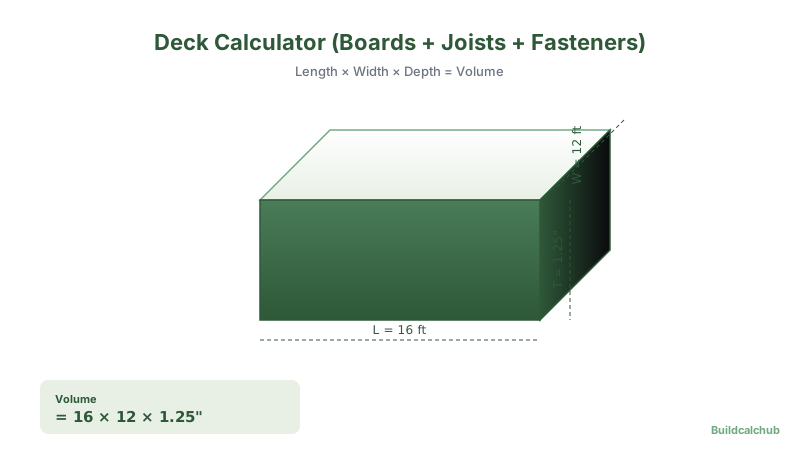
- 16 × 12 ft
- Board type
- 5/4 × 6 PT
- Joist spacing
- 16 in
Takeaway: Budget-friendly DIY project. Plan 2-3 weekends for completion. Stain within 6-12 months of install.
Composite Upgrade 14 × 20 ft
Composite deck upgrade for low-maintenance enjoyment.
- Dimensions
- 20 × 14 ft
- Board type
- 1 × 6 capped composite
- Joist spacing
- 16 in
Takeaway: Composite is 2-2.5× PT cost but eliminates staining forever. Include hidden fastener system (+$200).
Premium Ipe 20 × 24 ft
Tropical hardwood deck for coastal or luxury home.
- Dimensions
- 24 × 20 ft
- Board type
- 1 × 6 ipe
- Joist spacing
- 12 in
Takeaway: Ipe requires tight 12-in joist spacing and pre-drilling every screw. Labor-intensive but lasts 40-50 years.
Sources & Standards
These references are used for terminology, safety boundaries, and engineering assumptions. Local code, supplier specifications, and licensed design documents still control your project.
-
2021 International Residential Code, Chapter 5: Floors and Chapter 8: Roof-Ceiling Construction (decking + framing)
International Code Council
Cited for residential deck framing, joist spacing, and structural requirements.
-
USDA NRCS National Engineering Handbook — Erosion and Sedimentation
USDA Natural Resources Conservation Service
Cited for topsoil placement, slope stability, and drainage practice on landscaping projects.
-
Penn State Extension Center for Turfgrass Science
Penn State College of Agricultural Sciences
Cited for grass seeding rates, sod establishment, and turf-area volume calculations.
-
Sunset Western Garden Book / ANSI A300 Tree Care Standards
Sunset / ANSI
Cited for mulch depth recommendations, tree-well clearance, and landscaping best-practice spacing.
-
CPSC ADA Accessibility Guidelines for Buildings and Facilities
U.S. Consumer Product Safety Commission / ADA
Cited for sidewalk slope, patio threshold, and walkway accessibility requirements.
Frequently Asked Questions
How many deck boards do I need?
For 5/4×6 boards with 1/4-in gap: 1 board per 5.75 inches of deck width. A 12-ft deck (144 in) needs 144 / 5.75 = 26 boards. Add 10% waste for trim cuts and defects.
How far apart should deck joists be?
16 inches on-center for most residential decks. Drop to 12 in for composite diagonal installs, thin composite, or high-traffic commercial decks. 24 in is only acceptable with 2×6 wood boards in light-duty applications.
How much does a deck cost per square foot?
Installed in 2026: PT pine $15-25/ft², cedar $22-35/ft², composite $25-55/ft², tropical hardwood $45-70/ft². DIY subtracts 40-50% labor cost. Entry-level 12 × 16 ft PT deck costs $2,880-4,800 DIY, $4,800-8,000 installed.
How long does a deck last?
Pressure-treated: 15-25 years. Cedar: 20-30 years. Composite: 25-30+ years (but not forever). Tropical hardwoods (ipe): 40-50 years. PVC: 30-40 years. Proper annual maintenance and sealing extend all numbers significantly.
Do I need a permit for a deck?
Usually yes for anything attached to the house and over 30 inches off the ground. Always required for decks over 200 ft² or with roof coverage. Check with your local building department before starting — unpermitted decks cause issues at home sale.
How far can a deck board span between joists?
For 5/4×6 PT boards: 16 in max. For 2×6 PT: 24 in max. For 1-in composite: 16 in max (12 in for diagonal). For 6/4 composite: 24 in max (16 in diagonal). Always check manufacturer span tables for your specific board.
Should I use screws or nails for decking?
Always screws. Deck screws (stainless or coated) don't work out like nails, and hidden fastener systems provide cleaner aesthetics. Use minimum 2-1/2 inch deck screws for 5/4 boards, 3 inch for 2× boards. Budget 1 lb of screws per 20 linear feet of decking.