Fence Calculator for Posts, Pickets, Rails and Cost
Plan a fence by total linear footage — get post count, rail lineal feet, picket count, and material cost in one shot, across wood, vinyl, chain-link, and composite options.
Fence Calculator
Enter project dimensions below — results update instantly. Switch units freely.
Estimates assume typical industry density and waste factors. Always verify with your supplier and local building code before purchasing material.
Why Fence Calculator Estimates Go Wrong
Too-far-apart posts cause every major fence failure. Rails sag between posts; pickets tilt as the rails flex; the entire run racks in high winds. Tight post spacing costs marginally more upfront but extends fence life by 10+ years.
Standard spacings:
- Chain-link: 10 ft (top rail takes the load)
- Wood privacy (6 ft tall): 6-8 ft — 8 ft is IRC max, 6 ft is prudent for high-wind regions
- Wood picket (3-4 ft tall): 6-8 ft
- Vinyl privacy: 6 ft only — vinyl rails sag more than wood
- Composite: per manufacturer, usually 6-8 ft
- Wrought iron / metal: 5-8 ft depending on pattern
If your fence will see strong wind loads (open fields, hilltops, coastal), drop to 6-ft spacing regardless of material. The extra posts cost $150-300 on a 100-ft run; storm damage costs $2,000-4,000 to rebuild.
Post, Rail, and Picket Count Formulas
Rails = Length × Courses
Pickets = (Length × 12) ÷ Picket Spacing (inches per picket)
For a 6-ft-tall wood privacy fence:
- Posts: 4×4 or 6×6 pressure-treated, 2 ft below grade + fence height above = 8 ft total
- Rails: 2×4 or 2×6, typically 3 courses (top, middle, bottom) for 6-ft privacy
- Pickets: 1×6 × 6 ft, spaced at 5-5/8 in center-to-center (no gap privacy) or 7 in (spaced picket)
Concrete per post:
- 8-in diameter × 2 ft deep = 0.7 ft³ = 2 bags of 60-lb premix
- 10-in diameter × 2.5 ft deep = 1.36 ft³ = 4 bags of 60-lb
Once the Fence Calculator result looks reasonable, cross-check the next job decision with the Cement Calculator for post concrete, the Sonotube Calculator for tube-formed posts, the Board Foot Calculator to convert rail / picket counts to lumberyard BF pricing, or the Acreage Calculator to estimate fence length around a known acreage parcel.
What Most Online Calculators Get Wrong Reviewed by Ryan Mitchell, Landscape Material Planning Specialist (12 yrs)
AI tools calculate fence panels as length / panel width. Four pitfalls AI summaries hide:
- Post count = panels + 1. AI tools sometimes use panels only.
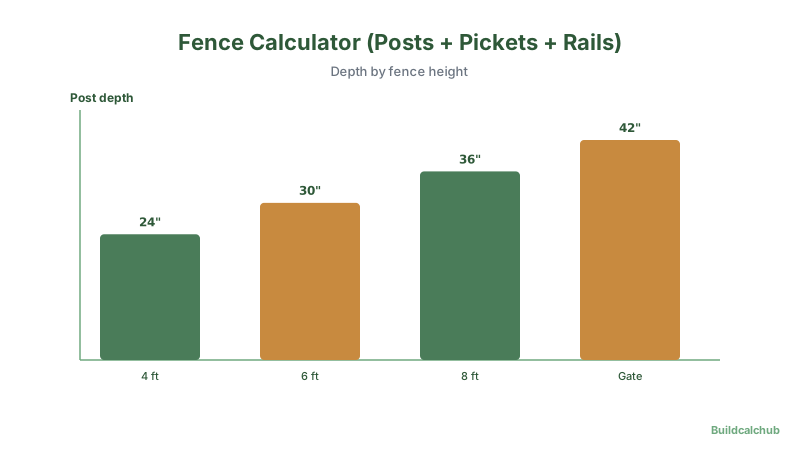
- Post hole depth = 1/3 fence height OR frost line, whichever is deeper.
- Concrete bag count: 2 bags per post (40–60 lb).
- Gate posts need 50% more depth + concrete.
This calculator outputs panels + posts + concrete + gate adjustments. Fence projects are 4 line items: panels + posts + concrete + gates.
Fence Coverage Table and Material Reference
| Fence Type | Material $/lf | Installed $/lf | Lifespan |
|---|---|---|---|
| Chain-link 4 ft | $7-10 | $14-25 | 15-20 yr |
| Wood picket 3 ft | $10-15 | $20-35 | 10-15 yr (wood) |
| Wood privacy 6 ft | $15-25 | $28-45 | 15-20 yr |
| Wood privacy 8 ft | $22-35 | $38-60 | 15-20 yr |
| Vinyl privacy 6 ft | $28-45 | $45-75 | 20-30 yr |
| Composite privacy 6 ft | $40-65 | $65-110 | 25-35 yr |
| Aluminum / metal ornamental 4 ft | $22-45 | $38-80 | 30-50 yr |
| Wrought iron 4 ft | $30-60 | $55-110 | 50+ yr |
Includes posts, rails, pickets/panels, gates, and typical hardware. Excludes labor for grading, stump removal, or difficult access.
| Fence Length | 6-ft spacing | 8-ft spacing | 10-ft spacing |
|---|---|---|---|
| 50 ft | 10 posts | 8 | 7 |
| 100 ft | 18 | 14 | 12 |
| 150 ft | 26 | 20 | 17 |
| 200 ft | 35 | 26 | 22 |
| 300 ft | 51 | 39 | 32 |
| 500 ft | 84 | 63 | 52 |
Count includes corner and end posts. Add 1 gate post per gate. Add 1 gate latch post per single gate, 2 per double gate.
Real-World Example Calculations
Backyard Privacy 150 ft × 6 ft Cedar
Standard backyard privacy fence with 1 single gate.
- Length
- 150 ft
- Height
- 6 ft
- Post spacing
- 8 ft
Takeaway: Typical 4×4 cedar posts, 2×4 rails, 1×6 cedar pickets. Add $1,800-2,200 labor if hired.
Front Yard Picket 60 ft × 3 ft White
Traditional white picket fence across front yard.
- Length
- 60 ft
- Height
- 3 ft
- Post spacing
- 6 ft
Takeaway: Pre-primed pine or vinyl picket panels simplify install. Allow time for 2 coats of paint if pine.
Large Property 400 ft Chain-Link 4 ft
Security fence around 1-acre property.
- Length
- 400 ft
- Height
- 4 ft
- Post spacing
- 10 ft
Takeaway: Chain-link is fastest and cheapest per linear foot for long runs. Upgrade to vinyl-coated fabric for aesthetics (+$2/lf).
Sources & Standards
These references are used for terminology, safety boundaries, and engineering assumptions. Local code, supplier specifications, and licensed design documents still control your project.
-
2021 International Residential Code, Chapter 5: Floors and Chapter 8: Roof-Ceiling Construction (decking + framing)
International Code Council
Cited for residential deck framing, joist spacing, and structural requirements.
-
USDA NRCS National Engineering Handbook — Erosion and Sedimentation
USDA Natural Resources Conservation Service
Cited for topsoil placement, slope stability, and drainage practice on landscaping projects.
-
Penn State Extension Center for Turfgrass Science
Penn State College of Agricultural Sciences
Cited for grass seeding rates, sod establishment, and turf-area volume calculations.
-
Sunset Western Garden Book / ANSI A300 Tree Care Standards
Sunset / ANSI
Cited for mulch depth recommendations, tree-well clearance, and landscaping best-practice spacing.
-
CPSC ADA Accessibility Guidelines for Buildings and Facilities
U.S. Consumer Product Safety Commission / ADA
Cited for sidewalk slope, patio threshold, and walkway accessibility requirements.
Frequently Asked Questions
How much does a fence cost per foot?
Installed in 2026: Chain-link $14-25/lf, wood privacy $28-45/lf, vinyl $45-75/lf, composite $65-110/lf, ornamental iron $55-110/lf. Material-only runs 40-60% of installed cost.
How far apart should fence posts be?
6-8 feet for most residential fences. Chain-link can go to 10 ft. Vinyl max 6 ft. In windy areas, always use 6 ft spacing. Closer spacing = stronger, longer-lived fence.
How deep should fence posts go?
Minimum one-third of post length. A 6-ft fence uses 8-ft posts buried 2 ft deep. For tall fences (8 ft+) or high wind, go to 30-36 inches. In frost zones, always go below frost line (24-66 in depending on climate).
How much concrete per fence post?
Standard 8-in diameter × 2-ft hole: 2 bags of 60-lb concrete (0.7 ft³). Heavier 10-in × 3-ft hole for gate posts or tall fences: 4 bags. Use fast-setting mix for faster installation.
What's the cheapest fence to install?
Chain-link ($14-25/lf installed) for utility uses. Wood picket ($20-35/lf) for traditional front-yard looks. Wood privacy ($28-45/lf) for privacy at moderate cost. Cheapest per-lf isn't always cheapest per-year — vinyl costs more upfront but outlasts wood 1.5-2×.
How long does a wood fence last?
Cedar or redwood: 15-20+ years with periodic staining. Pressure-treated pine: 10-15 years (posts often fail first). Composite and vinyl: 25-35 years. Wrought iron: 50+ years with rust maintenance. Post life determines total fence life — rotted posts cause collapse even when pickets are fine.
Do I need a permit for a fence?
Varies by jurisdiction. Many areas require permits for fences over 6 ft in back yard or 4 ft in front yard. Also required for fences on property lines, in historic districts, or affecting sight lines at corners. Always check local zoning before starting.